SEO Best Practices

Written by Brian Dean
What Are SEO Best Practices?
SEO best practices are the foundational tactics that help search engines find, understand, and rank your content. These practices include on-site optimization, keyword research, and backlink building.
Getting these right can help you rank higher on Google and earn more AI citations and mentions.
While there are a million things you can do to improve your website’s visibility, start with the basics of SEO.
Nail the foundation first. Then layer in advanced strategies.
Here are the most important SEO fundamentals you need to know in 2026:
- Add Your Main Keyword Early in Your Content
- Write Unique Titles, Descriptions, and Content
- Optimize Your Title Tag for SEO
- Improve Your Site’s User Experience
- Optimize Your Site’s Loading Speed
- Track Your Results With Google Search Console
- Optimize Images for SEO
- Use Internal Linking
- Publish Amazing Content
- Build Backlinks To Your Website
- Optimize Your Site for AI Visibility
1. Add Your Main Keyword Early in Your Content
It’s no secret that you want to use your keyword a handful of times on your page.
But you may not know that the location of your keyword also makes a difference.
Specifically, you want to mention your main keyword at least once at the top of your page.
Why does this matter?
Mentioning your primary keyword early helps search engines, LLMs, and readers quickly understand what the page is about.
For example, the following guide is optimized around “on-page SEO.”

And that term appears twice in the first 25 words of the content.

Simple.
2. Write Unique Titles, Descriptions, and Content
Avoiding duplicate content is one of the most important SEO best practices to keep in mind.
In fact, Google has stated that you should avoid “duplicate or near-duplicate versions of your content across your site.”

And this rule applies to every piece of content on your website, including:
- Title tags
- Meta tags
- Ecommerce product pages
- Landing pages
- Image alt tags
- Category pages
Basically: if you publish a page on your site, the content on that page has to be 100% unique.
If you run a small blog with a homepage and a bunch of blog posts, this rule is pretty easy to follow.
But if you’re an ecommerce site owner with thousands of products, writing unique content for each page can be tricky.
Tricky… but worth it.
If you’re having trouble writing content for each page, consider combining pages that have similar content and serve the same purpose. Or use the canonical tag.

3. Optimize Your Title Tag for SEO
When it comes to on-page SEO, your title tag matters.
Google has even said that “it’s important to use high-quality titles on your webpages.”

Here’s how to get the most out of your page’s title tag:
Front-Load Your Main Keyword
“Front-load” simply means starting your title tag with your target keyword.
Why is this important?
Well, search engines and AI systems use title tags to understand your core topic and assess a page’s relevance to users’ queries.

But don’t force it. Your title should still read naturally and accurately describe what the page is about.

Sometimes it’s not possible to use your keyword that early on because it will make your title tag look weird.
Yes, following search engine optimization best practices is important. But above all, your title tags need to read smoothly and be useful for humans.
If you’re not able to start your title tag off with a keyword, no biggie. Just include it as early on as you can.
For example, this page is optimized around the keyword “SEO strategy,” but it didn’t make sense to use it at the front of the title tag.

So we just used it as early as possible:

Use One Keyword per Title
Google has been really clear on this.
They don’t want you to stuff your title with a bunch of different keywords.

(Also known as “keyword stuffing.”)
Instead, use one main keyword in your title. And if your page is high-quality and helpful, you’ll naturally rank for that keyword… and lots of others.
For example, the Backlinko SEO Checklist was optimized around one term: “SEO checklist.”

That keyword appears in the title tag, and the other words just clarify what the page is actually about.

And because the page contains high-quality content, it ranks in the top 5 for the main keyword.

And, according to Semrush’s Organic Rankings Tool, this page also ranks for 476 different keywords.

Was it optimized around 476 keywords? Nope!
Just optimized around ONE important keyword. And Google largely took care of the rest.
Write Compelling, Shareable Titles
A compelling title can improve your click-through rate, helping you earn more traffic.

Once the SEO stuff is taken care of, start optimizing the title for clicks and shares.
In other words:
Write title tags that are interesting, compelling, and push people to share.
For example, this list of SEO tools has an eye-catching title.

4. Improve Your Site’s User Experience
Improving your site’s user experience (UX) can, directly and indirectly, help with your SEO.
UX can directly support SEO because poor page experiences may lead users to “pogo-stick” back to the search results, which can be a sign that the page didn’t meet their expectations.

If enough people bounce from your site to the search engine results, this tells Google that your result didn’t give that searcher what they were looking for.
And your search engine rankings can start to dip.

You can get a proxy measurement of pogo-sticking from Google Analytics. If your page has a really high bounce rate, this might be a sign that users aren’t finding what they’re looking for.

UX can indirectly help with SEO because people are more likely to share and link to a user-friendly site.

So if your site is hard to use, uses intrusive popups and ads, and has a bunch of broken links… people aren’t going to link to it.
(Even if you have great content.)
So yeah, UX is something that every site owner should pay attention to anyway. It just so happens that great UX can give your SEO a boost too.
5. Optimize Your Site’s Loading Speed
Google usually doesn’t talk publicly about the ranking factors in its algorithm.
But when they do, you know it’s worth paying attention to.
Site loading speed is one of those rare ranking factors.

This is why you should make sure your site loads as quickly as possible.
(Especially on mobile devices.)
Your first step is to benchmark your site’s current loading speed. That way, you know where you’re at before you start making changes.
PageSpeed Insights is super helpful for this.

After all, the recommendations you get from this tool come from Google itself.

Plus, it doesn’t just tell you if your page is fast or slow. The tool gives you a detailed report that includes ways you can improve.

Here are a few ways you can improve your site’s loading speed.
- Compress images: This is a big one. Images tend to make up the bulk of a page’s size (in terms of KB). Use a tool like Kraken.io to shrink your image sizes.
- Use lightweight themes: Bulky WordPress themes can slow things down. So if your theme isn’t optimized for speed, consider switching to one that is.
- Use lazy loading: Lazy loading images can boost your site’s loading speed by 50% or more. The downside is that images show up as users scroll down the page, which isn’t great for UX. So it’s a tradeoff.
- Use a CDN: CDNs serve images and other media on your site on servers that are close to your users.
6. Track Your Results With Google Search Console
Google Search Console is a free website analytics tool that tells you how your site is doing in the SERPs (search engine results pages).

There are a lot of cool features and tools in GSC.
But you probably won’t need most of them.
Instead, just check these 3 reports on a regular basis.
Performance: This data lets you know how many people see and click on your site in Google search.

You can also see the exact keywords that people use to find your content… and where you tend to rank.

This is all super valuable on its own. But the real value is tracking your impressions and clicks over time. If they’re moving on up, it’s clear that these SEO best practices are working.
If not, it may be time to try a different approach.
Page indexing report: This report lets you know which pages from your site Google has indexed.

It will also let you know if it’s having trouble fully crawling any of your pages.
If you see “errors” and “warnings” here, fix them ASAP.
After all, if Google can’t index your page, it won’t rank for or be surfaced in LLM responses.
Fortunately, Google doesn’t just tell you, “We can’t index this page.” They usually let you know what’s causing the issue.

Core Web Vitals: Google’s Core Web Vitals report shows how your pages perform on real-world loading, interactivity, and visual stability.

Considering that Google’s index is mobile-first, pay particular attention to your mobile scores here.
7. Optimize Images for SEO
If you use images on your page, make sure they’re optimized for SEO.
Fortunately, this is REALLY easy. All you need to do is keep these two image SEO best practices in mind.
Name Your Images with Descriptive Filenames
Google uses your image’s filename as one of the signals to understand what’s in your image.
For example, let’s say you have an image of pancakes on your site.

You wouldn’t want to name that image something like: image89.png.
Instead, use a filename that describes what’s in your image.

Use Image Alt Text
Google has said that they use alt text to understand images.

It takes a few extra seconds to write alt text for each image. But it’s worth it.
For example, you wouldn’t want your picture of pancakes to have alt text like this.

Just like with your filename, you want to write descriptive alt text that lets search engines know what your image is all about.

8. Use Internal Linking
Internal linking is one of the easiest best practices for SEO to implement.
All you need to do is add a link from one page on your site to another page on your site.

That said, you don’t just want to add a bunch of random internal links. Yes, random internal linking is probably better than no internal linking at all.
But if you want to get the most out of internal links, try these tips instead.
Use Descriptive Anchor Text
Using descriptive anchor text helps users and search engines understand the page you’re linking to.

For example, this internal link is linking to my page about “audience research.”

And, as you can see, the internal link’s anchor text has that exact term in it, but you can also use variations.
Send Authority to Pages That Need It
In general, you want to internally link to pages that don’t have much (if any) link authority.

When you do, you’ll send much-needed authority to that low-authority page… which can boost its Google rankings.
With all that said:
I wouldn’t overthink this step. In fact, I just tend to link from OLD pages to NEW pages.
Old pages tend to have more authority than new pages.
And this little shortcut helps me use internal links without having to analyze every page on the site.
9. Publish Amazing Content
If you’ve tried to learn SEO before, you’ve probably heard about the importance of “high-quality content.”
And it’s true: publishing original, helpful content can help you rank higher in Google and get more LLM mentions.
The thing is, what most people consider “high-quality content” has changed over the last few years.
The bottom line?
Your content marketing game needs to be on point. Which usually means an investment of time, money, and staff… or all 3.
We recommend the QRIES framework for creating high-quality content.
QRIES stands for:
- Quotes
- Research
- Images
- Examples
- Statistics

For example, Backlinko’s article, How to Create an SEO Strategy, includes examples, experiments, and campaigns we use at Backlinko to drive results. It has AI prompts, step-by-step instructions, and a sample brief you can steal.
There’s no getting around the fact that creating content that stands out takes a ton of work.
But if you’re willing to publish amazing stuff, you have a good shot of ranking in Google for your target keywords and improving your AI visibility.
10. Build Backlinks to Your Website
Are backlinks still an important Google ranking signal?
Yup!
Google still uses links to judge the quality of your site’s content.
Just look at the number of links pointing to sites that rank in Google’s top 10 for a term like “project management software.”

But here’s the thing:
Link building has changed.
It’s not just about backlinks anymore. Unlinked brand mentions and co-citations now play a major role too.
A co-citation is when your brand gets mentioned alongside recognized authorities in your niche, whether there’s a link or not.
Why does this matter?
Because LLMs and AI tools pull information from all over the web.
When your brand gets mentioned consistently in the right places, it influences where you show up — in AI Overviews, traditional search results, and LLM responses.

So how do you build links and mentions?
- Focus on content formats that naturally attract backlinks: Free tools, comprehensive guides, and original research, charts, and infographics all earn links because people want to reference and share them
- Create content with a hook: A hook is a data point, a fresh angle, or something genuinely useful that makes people want to cite you
- Target authoritative sites in your niche: Use Semrush’s Backlink Analytics tool to analyze your competitors’ backlink profiles to see who links to them. That way, you can target the same sites.
11. Optimize for AI Visibility
Google isn’t the only place people search for answers anymore.
More and more people are turning to AI tools like ChatGPT, Gemini, and Google’s AI Overviews to get answers to their questions.
And that changes what “SEO” actually means.
We’re in the “search everywhere optimization” era now.
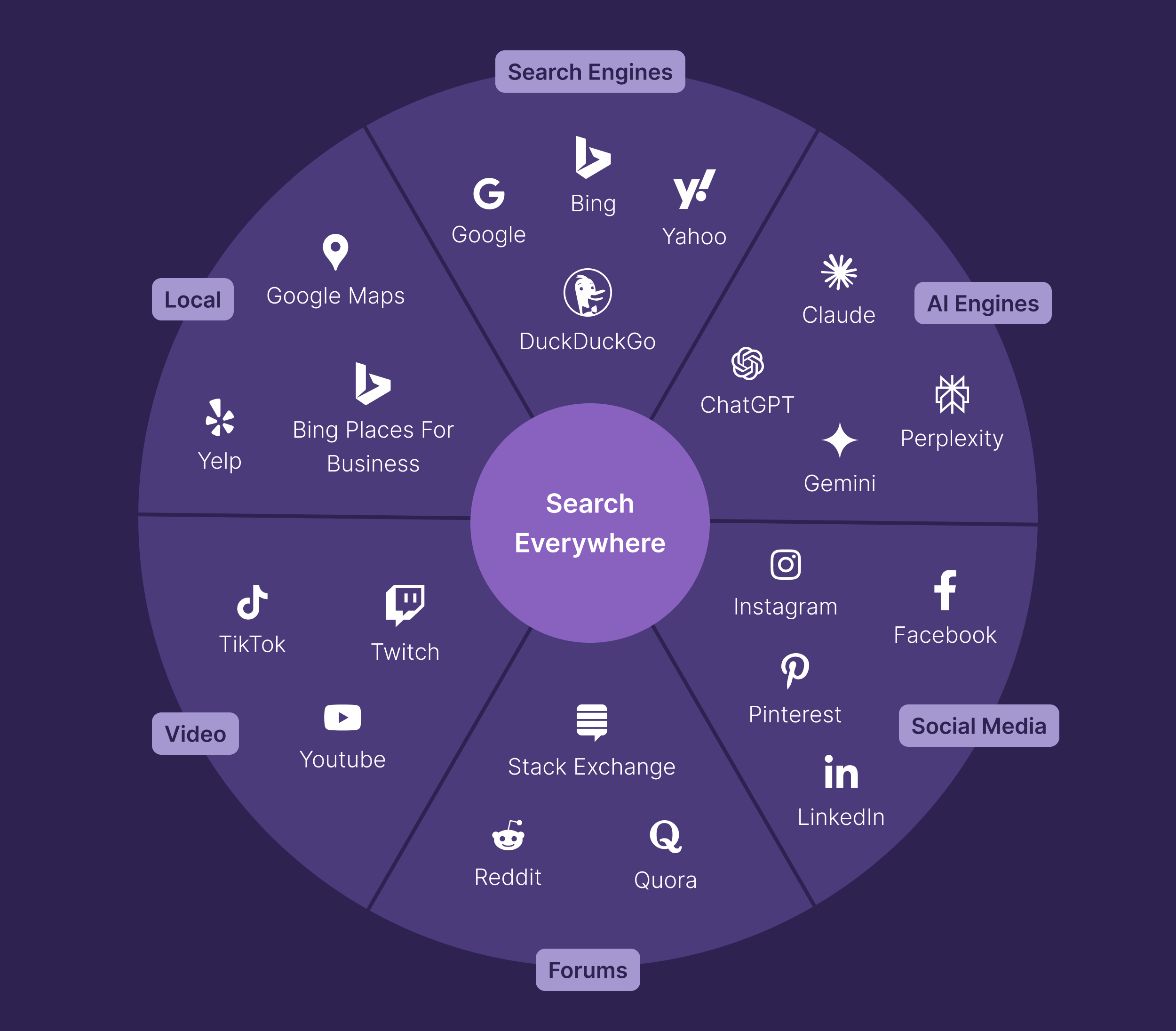
AI systems assemble answers by pulling relevant information from multiple sources across the web.
That means your content doesn’t need to rank #1 to get cited.
If a specific passage clearly answers part of the query, it may be surfaced in an AI Overview or LLM response.

But it also means that content that isn’t clear, structured, and authoritative may not show up at all.
So how do you show up in AI answers?
Lead with Clear Answers
AI Overviews pull content that directly answers questions. Put your main point at the top of each section. Don’t bury it.
For example, this article on AI + SEO competitor analysis has a summary of everything you need to know right in the second paragraph.

Structure Your Content So AI Can Parse It
Use logical headings, short paragraphs, and distinct sections.
AI tools pull individual passages, not entire pages. Make every section stand alone.
Here’s an example of how we do that at Backlinko:

Build Your Brand Presence Beyond Your Website
Repeated brand mentions influence which sources AI tools cite, even if you don’t get a backlink.
Getting mentioned consistently in forums, newsletters, and industry publications builds the kind of authority AI systems recognize.

Earn Mentions, Not Just Links
Create content with original research, data, and frameworks that people naturally want to reference.
When others reference your work, it can increase your visibility and authority signals across the web.
Tools like Semrush Brand Monitor can help you track where you’re getting mentioned.

The good news?
Everything in tips 1–10 already moves the needle here.
Strong content, quality backlinks, and a well-structured site are still the foundation.

Ready to Track Your Results?
You now have 11 SEO best practices to put into action.
Start with the basics: title tags, internal links, page speed. These are quick wins that compound over time.
Then build toward the bigger plays: amazing content, backlinks, and AI visibility.
The next step is knowing whether any of it is working.
Check out our guide to SEO Metrics to learn exactly what to measure.