Your landing pages, product pages, and service pages convince people to trust your brand and (hopefully) buy what you’re selling.
But they can’t start convincing until they’re discovered.
That’s where SEO copywriting comes in. It’s the job of balancing SEO principles with persuasive copywriting, so that your most powerful pages are actually seen by real people.
Here’s an example with a product page on Gymshark.
SEO copywriting helps this page appear as the first result in Google:
And it also helps it get linked in an AI answer:
The commercial pages that rank in Google, earn rich results, and get recommended in AI all have one thing in common.
They’re all built around the buyer’s situation and the seller’s expertise.
In this article, we’re going to discuss a simple, four-step process for SEO copywriting (and give you a messaging toolkit to get started today). We talked to practitioners doing this work every day to build it.
But first, what exactly is SEO copywriting?
What is SEO Copywriting?
SEO copywriting involves creating a page that’s built to persuade your audience to take action, but also gets ranked in Google.
And no, striking that balance is not easy.
As Kaleena Stroud, Content Marketing Manager at Triple Whale, said, “SEO copywriting is all about assembling things like Tetris.”
Mainly, that’s because it’s the only type of marketing writing that has to combine two main goals.
Marketing writing can be separated into three core buckets:
Content writing: Includes blogs, guides, or newsletters with the goal to inform
Copywriting: Any page with the goal to persuade someone to do something (like buy a product or book a meeting)
SEO copywriting: Commercial pages at the intersection of persuasion and discoverability — these pages are built to convert, but also to be found in search
Getting your commercial pages ranked in Google or cited by AI takes more than dropping in a few keywords.
You need a page that serves the buyer first — because that’s what both Google and AI want to recommend to users.
Let’s go through the four steps:
Understand your buyer’s situation
Build your messaging strategy document
Write copy that converts
Build pages that get visibility in search and AI
To make this easier, follow along with our free SEO Copywriting Messaging Toolkit. The toolkit follows some of the main steps in this guide — so by the time you finish reading, you’ll have a finished messaging doc, not just notes.
Step 1: Understand Your Buyer’s Situation
Before you write a single word, you need to know three things:
Who exactly is landing on your page (and what are they feeling at that moment)?
What are they searching for?
What’s the rest of the web already telling them?
This is the research layer that everything else builds from.
Do Audience Research
You don’t have to invent a new message. You just assemble it from what your buyers are already saying.
That’s the beauty of voice-of-customer (VoC) research.
First, mine what’s available online.
Let’s say I’m doing SEO copywriting for an e-reader accessory. I’d dig into subreddits like r/ereader or r/kindle to see what questions people are asking.
I’d also check high-engagement posts to spot conversations happening naturally.
Industry forums like Mobile Read are worth a look too.
What you’re looking for is verbatim, unique phrases that are coming from the mouths of your ICP.
Want to pull this data together quickly? Use AI to scan through Reddit and reviews.
Use this prompt:
I’m doing voice-of-customer research for [product/service], which helps [ICP] do [job-to-be-done]. Search Reddit, review sites, and forums for discussions from people in this audience talking about [the problem this product solves] and [the product category].
Pull direct, verbatim quotes: Their exact wording, not paraphrased. For each one, give me:
The quote
Where it’s from
Whether it’s describing a pain point, a desired outcome, an objection, or how they currently solve the problem
Group the quotes by theme, and call out any phrases or specific language that come up repeatedly across different people.
That can give you a response like this:
Which is a great place to start (just make sure to double-check the sources manually).
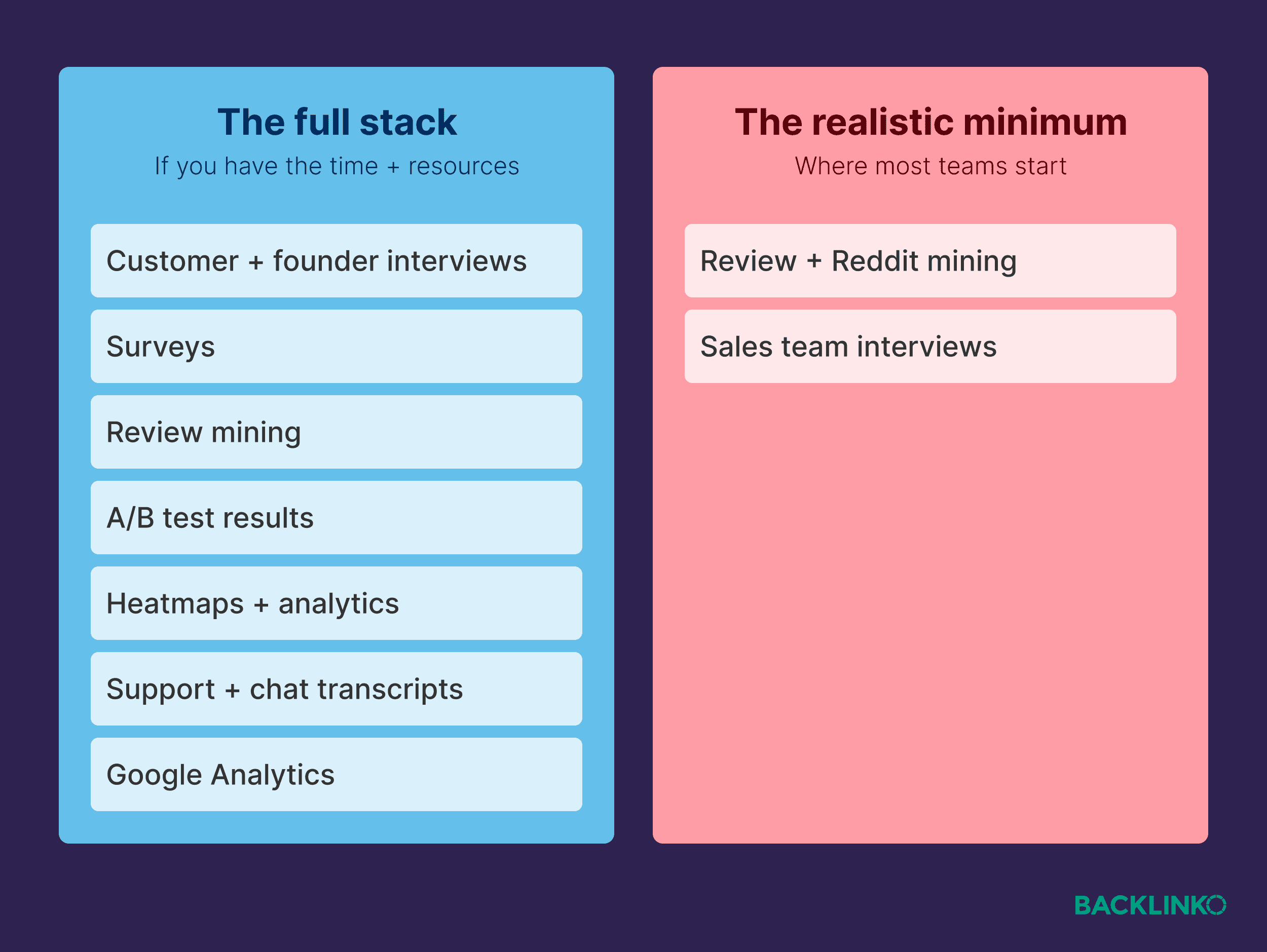
Second, use whatever internal resources are available to you.
For example, an ecommerce brand may have on-site reviews.
B2B companies might have recorded sales calls. Software companies may have notes from beta testers.
“The ideal thing is the whole shebang. But not every team has that. If your resources are limited, talk to your sales team. They usually know people’s objections and how to respond to them.”
Don’t aim for perfect. Just start — even with the bare minimum.
Gather all of this raw data in one place. Later on, we’ll analyze it to build your messaging strategy.
Find Keywords That Match Transactional Intent
Keyword research for SEO copywriting means confirming your buyer is ready to act (and finding the exact terms that signal that readiness).
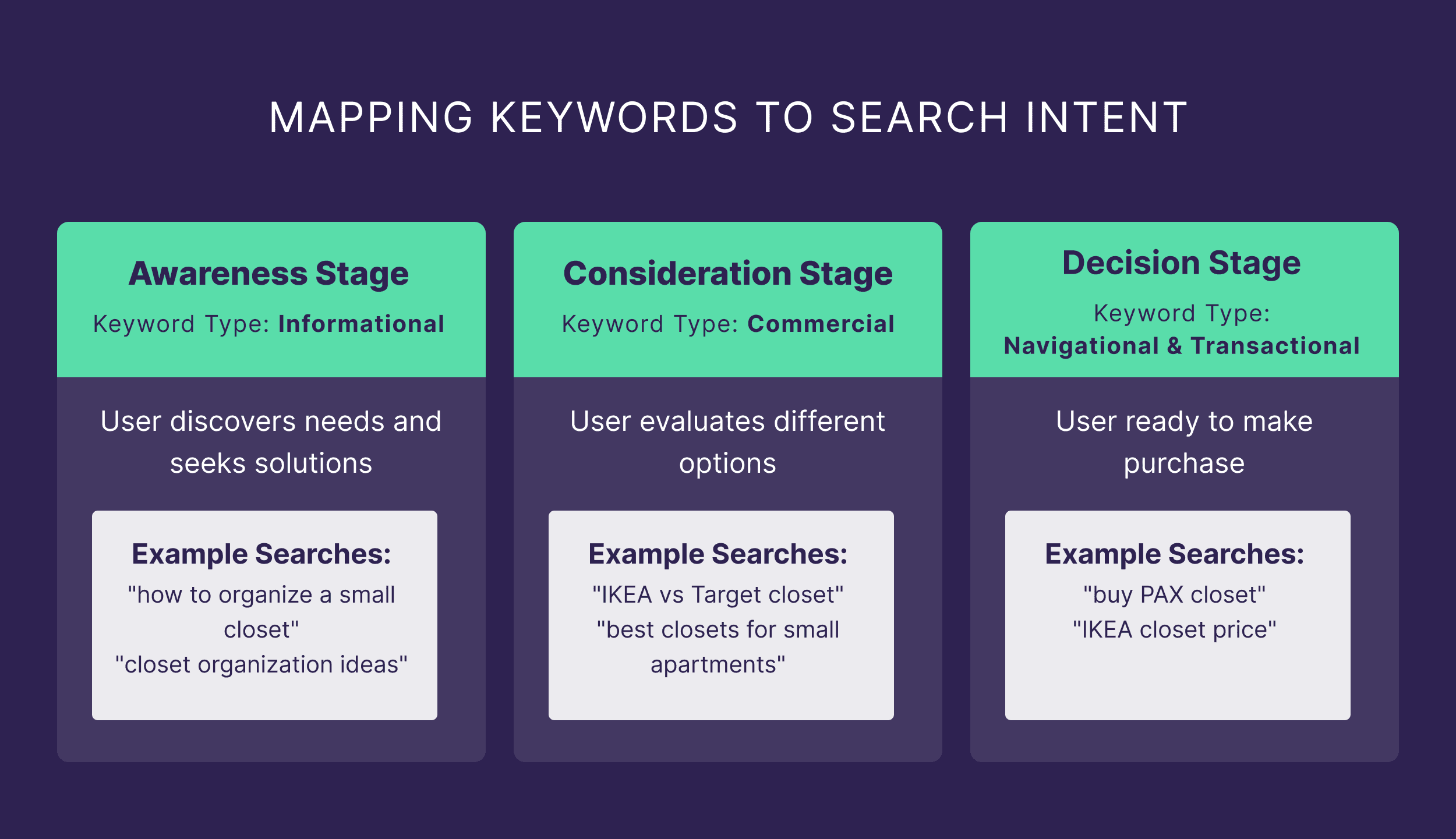
Product and landing pages normally serve transactional or navigational intent.
The searcher already knows the category or type of product they’re looking for. Now they’re looking for a place to buy.
Here’s how to find keywords with the right search intent.
First, start with broad keywords, then narrow down. Begin with your category keyword and drill down to the specific, product-level terms buyers use when they’re ready to purchase.
You can use a tool like Semrush’s Keyword Magic Tool to get ideas. First, add your category keyword. Then, filter the results to see keywords with Transactional or Navigational intent.
As you pick your keywords, read the SERP to confirm the intent.
What ranks tells you how Google reads the query.
For an HVAC business, “tankless water heater installation” looks transactional (especially since it’s a service they offer).
But the SERP is full of videos and how-to content, not service pages.
Add “near me” to that same query, and the results flip to local providers:
That’s a match for transactional search intent — and the keyword to target.
As you do this, pull data from your audience research. The pain points and use cases you gathered earlier point straight to keywords — the exact problems and situations buyers search for.
Remember: how you describe your product or service may not necessarily be how your audience describes it.
Pro tip: Use Google Search Console to get first-party intent data. If the page you’re optimizing already exists, check the exact queries people used to find it in the past. If you’re building a new page, look at what queries bring people to related pages on your site.
Study What’s Already Being Said
When you understand the gaps in what’s already online, you can fill them with insight only you have.
This step is about building differentiation through competitor research.
Start by reading the pages that rank for your target keyword. Look at their messaging, claims, the angle they lead with, and who they’re writing for.
For example, these category pages both rank for terms like “moisturizers for dry skin.”
And they basically repeat the same words over and over again.
That repetition is your map. The white space — what’s not being said — is where your product, expertise, or point of view can add something genuinely new.
Next, check what AI is saying.
Ask ChatGPT, Perplexity, or Google’s AI Mode about your product category and the problems it solves.
Chris Shirlow, founder of FourHorse Digital, has built this into his process.
“Now we’re writing for systems that synthesize an answer and decide what to cite. If there’s no first-person stance worth pulling, that page isn’t useful.
Before I write anything now, I run the models and watch where the answers get vague or hedge toward a safe consensus. That’s where my client knows something the models don’t. We’re filling holes AI can’t fill on its own.”
Those vague spots are exactly where your buyer needs a real answer, and where your firsthand expertise becomes the thing worth writing.
Keep all of this next to your audience research. It’s the raw material that will help you build your messaging strategy and write powerful copy.
Step 2: Build Your Messaging Strategy Document
Research only pays off if it lands somewhere usable. The messaging doc turns scattered findings into a single source of truth that your whole team can use.
Here’s exactly how to build it.
Set a Main Priority for This Page
With SEO copywriting you’re attacking two goals at once: rank in Google, and persuade a reader to convert.
That can create tension, which Yongi Barnard has felt firsthand.
“When doing conversion copywriting, working with SEOs can be tricky because the priorities are different. SEOs want the keyword. Copywriters want the clearest, most persuasive message. At some point, you need to decide what the page’s main job is.”
What happens when both ranking and persuasion try to be equally dominant? In Yongi’s experience, the resulting page is lackluster.
So, start by pinning down three things:
The page type
Where this page sits in the customer journey
How people find it
For example, a page buyers reach through branded search — like this Brooklinen product page — can lean more on creative, persuasive copy.
After all, they’re already pulling 11k in monthly search traffic from branded keywords.
But a page built to rank for a transactional keyword — like this page from Doordash — needs to lean harder on SEO.
Either way, treat the keyword as one input, not the boss of the page.
Write that lead priority at the top of your messaging doc. Everything you build next answers to it.
(If you didn’t get it yet, download the SEO copywriting messaging toolkit here.)
Synthesize Your Data
Right now, you’ve got a pile of raw material — Reddit threads, reviews, sales call notes, interview transcripts.
But before any of that can shape your copy, you need to find the patterns.
What pain points keep coming up? What phrases do buyers keep using to describe the issues they’re facing?
Drop every quote into a spreadsheet and tag each one by theme. The VoC Research Tracker tab in our SEO Copywriting Messaging Toolkit is built for exactly this — paste, tag, and let the patterns surface.
Most VoC quotes fall into a handful of buckets:
Pain points: The problem in their own words
Objections and hesitations: What makes them pause before buying
Desired outcomes: What “solved” looks like to them
Sticky phrases: Vivid wording you can use almost verbatim
Doing this exercise manually is obviously time consuming (I know). But reading every quote yourself is how you absorb your customers’ language.
When twelve people describe the same frustration in a similar way, you’ve found a theme — and you can start mapping those pain points to specific use cases (using Tab 2 of the toolkit).
Pro tip: If you’re working with a lot of material (hundreds of reviews, hours of call transcripts) AI can speed up the first pass. Paste your raw research into Claude or ChatGPT, and ask it to cluster the quotes into themes and flag phrases that repeat across sources.
Just remember that it’s pattern matching, not fact-checking — it’ll sometimes smooth out a rough customer phrase into marketing-speak, especially when dealing with transcripts. Treat its output as a rough draft, and verify every phrase against your real sources before it makes it into your copy.
Create a Clear Messaging Strategy Document
It’s time to turn everything you’ve gathered into one working document.
As Yongi Barnard puts it:
“The messaging strategy is basically where everything from the audience research and what I know about the product comes together. It defines the direction of the copy, and sets boundaries for what goes in.”
She structures her messaging strategy documents around four main parts:
First, collect the must-knows. These are the basics that frame everything else: the page type, its main goal, and where it sits in the customer journey.
Second, add your core argument. In one line, why this brand is the right fit for this specific audience. It’s basically the thesis of your landing page.
Third, define the product details. This includes things like:
Positioning
Value proposition
Differentiators
Main features
Who it’s best for (and who it’s not for)
How it works
Pro tip: Don’t worry about building this from scratch. You probably have most of this on hand already, or can pull it together quickly. Positioning and value props often live with your product marketing team, or in a brand deck. Differentiators and main features can come straight from the founder or product team — a quick conversation is often all it takes.
The goal is to get this written down in one place, next to audience research, so it’s actually useful when you sit down to write.
Lastly, add your audience information. This is where your research pays off. Write down the main job to be done, motivations and pain points, and the most common objections.
With everything in one place, this document serves more than a single page. It can give your whole team one consistent story to tell (exactly what AI citations thrive on).
Step 3: Write Copy That Converts
It’s time for pure copywriting craft.
Every tactic here traces back to the research and messaging doc you put together in the previous steps. That way, you avoid the dreaded blank page — you can just put together copy from what you already know about your buyer and your product.
Write From the Situation, Not the Feature List
A user searching with transactional intent wants to buy something.
Your job is to answer the questions that stand between them and a purchase:
Does this fit my situation?
Will it work for my use case?
What happens if it’s wrong for me?
For example: “double-walled vacuum insulation” is a nice feature.
But what the buyer wants is “ice-cold water for 24 hours, even in a hot car.”
The second version puts the buyer in a moment they recognize (and often mirrors real search queries).
To start, look at the pain points and use cases you mapped above. What’s the tipping point where someone decides it’s time to search for a solution?
Here’s a great example from bookkeeping service business, Bench:
This page speaks directly to the audience’s situation and main pain points: they’re behind on bookkeeping and taxes, and they’re too overwhelmed to do it on their own. That’s a prime example of using your buyers’ exact language.
The sharpest situation-first copy even names who the product isn’t for. It feels counterintuitive, but calling out the wrong-fit buyer builds trust with the right one. And it can filter your traffic down to the people who are more likely to convert.
Of course, while writing your page’s copy, you need to keep your balance between functionality and value.
“Commercial pages should provide informational value — a light-on-text sales page isn’t going to work as well now with AI. But we also need to be careful not to fall into the trap of recipe-blog-ification of commercial pages.”
In the real world, that means answering the questions your audience needs to know before purchasing, but without adding unnecessary fluff.
That’s exactly what Caraway does with their product pages. They answer common questions searchers are asking, like:
Will this pan work on an induction cooktop?
Can I use this pan in the oven?
What’s the pan made of?
How do I clean this pan?
Which is why their product pages both rank in Google and get cited by AI for those high-intent searches:
Lean on your keyword research: What questions are people actually asking? That tells you what information should go on your commercial page.
Say Something the Rest of the Web Can’t
Being comprehensive is table stakes now. And in most cases, that won’t be enough to rank in Google or get cited by AI.
You already studied what’s being said in Step 1. Now, it’s time to include what the rest of the web is leaving out. Take a stance, give advice based on your expertise, or include details that your competitors are glossing over.
Chris did exactly this for an electrician’s service page in South Philadelphia.
Instead of vaguely claiming to “work on old homes” like competitor pages, this page names specific South Philly neighborhoods and digs into the real problems of those pre-war rowhomes.
This page now ranks in the top 3 for “electrician in south philadelphia” and earns a spot in the local map pack.
But what if you don’t have proprietary experience to include in your commercial page?
Borrow credibility from a trusted expert.
That’s exactly what CeraVe does with the product page for their moisturizing cream.
Above, we saw the other competing moisturizers basically say the same thing over and over again. CeraVe goes beyond saying “this moisturizes” and uses a real expert to explain the mechanism behind it.
And it pays off: the page ranks #1 for “moisturizer for normal to dry skin” and gets pulled into AI Overviews for detailed queries like “sensitive skin care routine.”
This is exactly the kind of SEO copywriting that gets rankings and citations — copy built around the buyer’s situation and the seller’s expertise.
Work in Your Keywords (Without Ruining the Copy)
Your title tag, meta description, and H1 are your buyer’s first point of contact. So they do two jobs at once: signal the keyword and speak to the buyer’s pains.
Here’s how to fit keywords without flattening your copy.
Write the persuasive copy first. Then, once it’s down, look for natural places to add your keywords, like:
Crossheads (H2s and H3s)
FAQs
Product or service descriptions
Objection-handling sections
Ruggable’s category page for kitchen rugs does this well. It includes main keywords early on:
And brings them up again later in H2s and the FAQ sections:
Which is probably helping this page rank in the top 10 for almost 700 keywords:
But what if the keyword and your best line are fighting for the same space? Here’s what Kaleena Stroud advises:
“If you have a line you’re in love with that doesn’t include the SEO keyword, you may have to ‘kill your darling.’ There’s no point in great copy if people can’t discover you. I may pop my ‘fun’ copy into eyebrow headlines or microcopy somewhere, and keep the clear SEO keyword and message front and center.”
Step 4: Build Pages That Get Visibility in Search and AI
Your copy is written. Now it’s time to take care of the technical and brand-side details that help both search engines and AI systems read, trust, and surface your page.
This step is about giving your page the best chance to show up.
Earn Rich Results With Schema
Schema markup (or structured data) is code that tells search engines what the elements on your page actually are.
One caveat: Schema isn’t a ranking factor, and it won’t get your page cited by AI on its own.
What it does is make your page eligible for rich results — the enhanced listings that show details like star ratings, price, or shipping and return information right in the SERP, before anyone clicks.
For a commercial page, that’s valuable real estate.
Here’s what to prioritize depending on the page type:
Product pages: Use Merchant Listing markup. Prioritize price, availability, and rating.
Service pages: There’s no specific rich result for services, so focus on Organization markup and any review markup you’re eligible for
Location pages: Use LocalBusiness markup for hours, address, and service area. These details help support map pack and local visibility.
When your messaging is scattered — one thing on your product page, something different on Amazon, another in a review — AI has a harder time forming a confident recommendation.
Everything you do here should have its foundation in your brand’s homepage. The homepage’s job is to tell Google and AI who your brand is and what it’s known for. It’s the reference point every other page (and every third-party source) should echo.
Here’s how to build a consistent brand story:
Anchor your brand to a clear, specific idea, and repeat that wherever you can across the web
Use the messaging strategy doc that you built above as a single source of truth across different channels
Make sure third-party listings (marketplaces, retailers) reflect the same positioning as your own site
Encourage reviews that mention your core use cases
Caraway has done this by building their brand around non-toxic cookware.
The foundation is built with the copy on their brand homepage:
Both their own product pages and third-party sites echo that story.
Because of that consistency, AI has picked up on the storyline. And it repeats it back, even in non-branded searches:
Prepare for Agentic Shopping
Up to now, a real human had to click onto your landing page or product page in order to make a purchase.
Today, AI agents can now discover products, compare options, and complete checkout — sometimes without a person ever visiting your site.
At Google I/O in May 2026, Google introduced its Universal Cart, where an agent can handle the purchase across retailers in the background through its Agent Payments Protocol (AP2).
Other AI systems are also rolling out buy-in-chat features.
Obviously this is all still early, and it’s shifting quickly. But you can start to prepare now for a future where AI agents make some purchases on your site on behalf of people.
The good news: most of what you’ve already done still applies.
Your research, keyword data, and consistent brand story all carry over — agents discover and recommend products based on what real people describe.
That’s where an SEO copywriter’s job becomes so crucial.
The agent wants to see if your page matches what the buyer wants. So when you write clear copy that highlights who your product is for and what problems it solves, AI agents have an easier time matching you to the right buyers — even if a human never lands on the page.
A few technical details help you prepare:
Keep your product and service data clean and current, with accurate pricing, real-time availability, and complete details
Maintain a clear site structure, with semantic organization (good for humans and agents)
Add an llms.txt file to your site to prepare for a more agentic web. This isn’t for visibility, since crawlers and AI bots don’t need an llms.txt file to read your website. But it can make it easier for AI agents to complete tasks on it.
No matter where the future of agentic shopping is headed, building clean, accurate, and well-structured product data is still best practice for human buyers.
Let’s be real: it takes time to put together audience research, build a messaging strategy, and set up the technical side of your pages.
But the result is a page built for buyers — and one that gets visibility.
That’s the main goal of SEO copywriting.
So, use the SEO Copywriting Messaging Toolkit. It’ll take you from scattered research to a finished messaging doc, so you’re not staring at a blank page.
And if you want to learn more about the craft of copywriting, check out our guide to copywriting here.
Backlinko is owned by Semrush. We’re still obsessed with bringing you world-class SEO insights, backed by hands-on experience. Unless otherwise noted, this content was written by either an employee or paid contractor of Semrush Inc.