

Fintech in AI search plays by much stricter rules.
Because it’s a Your Money or Your Life category, products must clear higher verification thresholds before AI mentions you:
- Is your product legitimate?
- Are your fees and protections explicit?
- Do other trusted sources back up your claims?
To find these answers, AI draws from your website and the wider web — including sources you don’t control.
That risks misrepresentation of your brand.
What matters, then, is whether those sources tell an accurate story.
In this article, I’ll explain how to influence that narrative.
Because the real goal is for your fintech brand to show up in AI search AND be represented accurately.
3 Types of AI Visibility in Fintech
Your fintech brand can appear in AI search in three ways.
Your goal is to show up in all three.
- Mentioned when AI explains topics in your category
- Cited and linked within the answers
- Recommended as part of a shortlist of products

Brand Mentions
Brand mentions are when AI systems include your name in an answer.
They’re great for brand awareness.
These references put your name in front of buyers even when they’re not seeking you out.
For example, I asked ChatGPT:
“Are buy now, pay later providers ideal for my business?”
It mentioned several BNPL platforms in its response.

This suggests the AI recognizes those brands as part of the category and relevant in the space.
You’ll often see mentions as:
- Lists embedded inside explanations: “Popular BNPL providers include X, Y, Z…”
- Examples supporting a point: “Some neobanks, like X and Y, offer…”
- Context for user stories: “Many users switch from traditional banks to apps like X…”
A mention isn’t a recommendation, but it still matters.
Mentions often appear in non-brand queries. That’s when users begin exploring their options.
And if they see your brand mentioned often, it builds familiarity.
(Also known as the mere exposure effect.)

So, by the time a user reaches the decision stage, they’re more likely to recognize your name.
But sometimes that isn’t enough.
That’s why having a positive brand sentiment is vital.
The way AI mentions your brand can shape buyer perception.
If it often frames your product as “known for strong security,” that idea sticks.
But if the AI always pairs your name with warnings like “high fees” or “frequent outages,” it can raise doubts.
Citations
Citations are when the AI uses your pages to support its answer.
They’re valuable for boosting credibility and consumer trust.
When AI uses your content as a source, there’s an implied endorsement. It references you because you’re trustworthy.
And when you’re consistently cited, your brand becomes associated with expertise in the topic.
Citations may appear differently across platforms and prompts.
Sometimes they appear as footnotes and/or as inline links.

You might also see a sidebar or expandable panel with grouped sources.

Other times, citations appear as thumbnails somewhere in the AI’s response.

Regardless of format, the principle is the same:
When the AI cites your documentation, it signals that your content is being treated as a reliable source.
It’s pulling information from your pages to build its answer.
And this allows you to influence how the AI explains your product.
For example, I asked ChatGPT:
“What reporting and analytics does Klarna offer brands after implementation?”

Many of the citations came from Klarna’s documentation.
This implies that Klarna has some level of influence over the AI’s answer.

There’s a caveat with citations, however.
LLMs might link to your site, but that doesn’t always mean more traffic.
Citations are less visible than brand mentions or recommendations.
I rarely click them myself.
If I need more detail, I’ll usually continue the conversation within the platform. Or switch to Google search.
That’s likely true for many users.
Still, citations signal that AI systems trust your documentation.
And that trust enables product recommendations, which we’ll cover next.

Further reading: E-E-A-T in the AI Era: Complete Guide + Free Audit
Product Recommendations
Product recommendations are when AI includes your brand or product in a shortlist.
They’re the most impactful type of AI visibility because they influence which brands users consider.
And ultimately, which product they choose.
Here’s what recommendations look like in ChatGPT and Google AI Mode.
I asked:
“Which BNPL platform is good for mid-size ecommerce brands?”
Both listed Klarna as one of the top options.

This places Klarna front and center as buyers narrow their options.
Showing up in high-intent queries is vital for recommendations.
These are prompts that include “top,” “best,” “compare,” or “alternative.”
Such as:
- What are good alternatives to X for a small business
- What are the best budgeting apps for freelancers
- List the best neobanks with high-yield savings

But showing up in these queries isn’t automatic.
AI systems use specific signals to decide which brands to recommend.
How LLMs Choose Which Fintech Brands to Feature
AI acts as a filter between buyers and brands.
So how do these systems decide which brands and products to recommend?
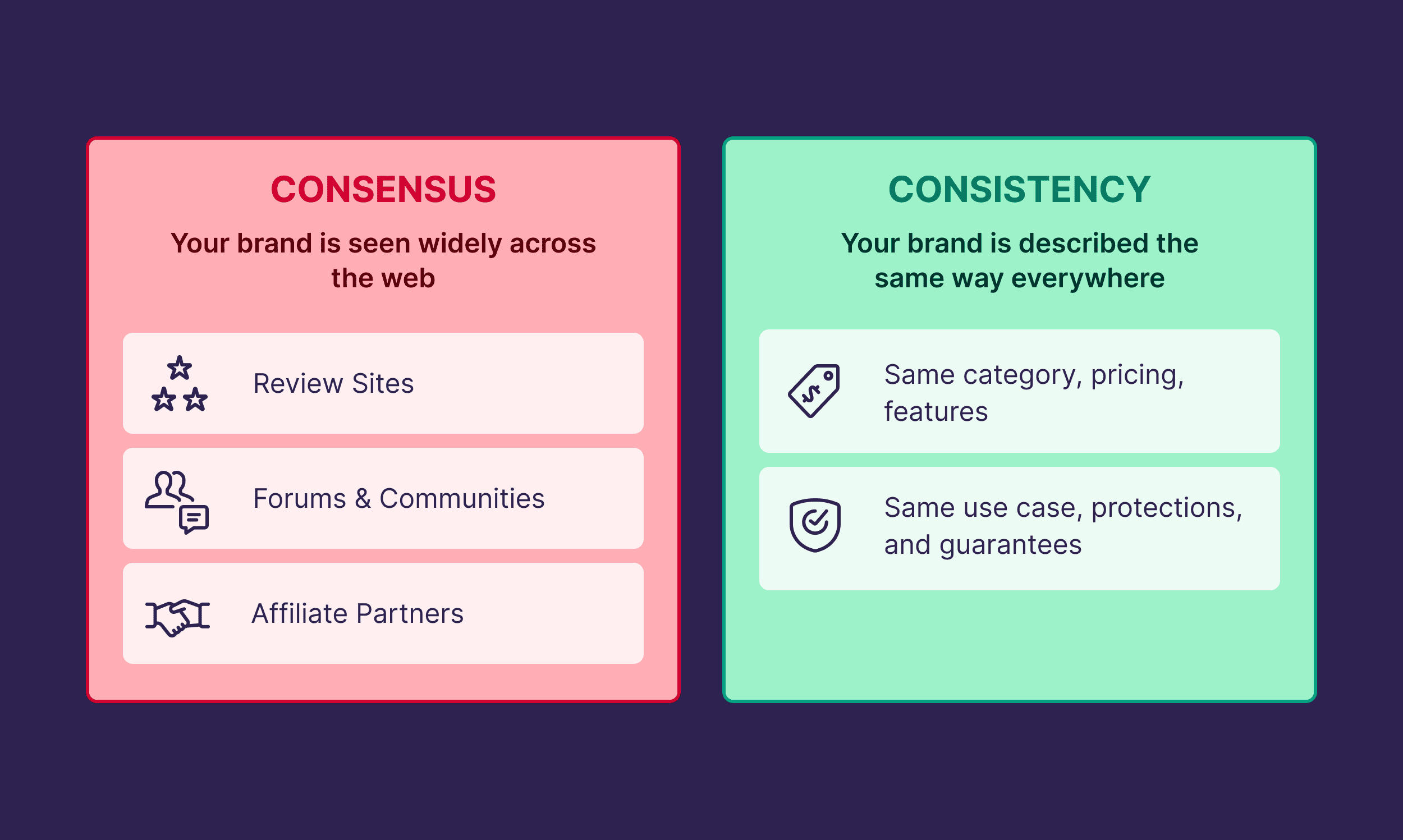
From what we can observe, comes down to two signals: consensus and consistency.
Consensus
Consensus is when multiple reputable sources mention your brand and product.
AI surfaces brands that have this kind of social proof — it suggests that you’re real, trustworthy, and worth recommending.
The stronger the consensus, the more confident AI is in featuring you.
But this cuts both ways.
If sources consistently highlight negatives, AI may repeat those warnings instead.
In fintech, AI systems likely assess consensus from several sources, including:
- Partner-bank and infrastructure disclosures
- Regulatory databases
- Personal finance publishers
- Finance communities and review platforms
- Partner sites
- Technical and investor communities

So, a big part of AI optimization is showing up in the sources LLMs use to form consensus.
The easiest way to identify those sources is to run brand-related prompts.
Example: “Best banks for international transfers.”
Then, check which sites appear in the citations.

Those are the sources the AI model trusts.
When these sites and reviews talk about your brand, it increases your chances of being mentioned by AI.
Further reading: Read our search everywhere optimization guide for tips on building a positive brand reputation across platforms.
Consistency
It’s not enough for your brand to be mentioned everywhere. The sources also need to agree on the facts they’re sharing about you.
That means the core details of your product align all over the internet, including your:
- Category
- Pricing and fees
- Product features
- Protections
For example, I asked ChatGPT and Google AI Mode for “best budgeting apps.”
Both recommended YNAB (You Need A Budget).

That’s no surprise.
YNAB appears in dozens of reputable sources, including Money, CNBC, NerdWallet, and Wirecutter.

It’s also frequently mentioned in finance communities, such as myFICO Forum.

These sources also highlight specific use cases: college students, goal-setting, and overall budgeting.
These consistency signals help AI confidently recommend YNAB for those exact scenarios.

Building consistency across platforms comes down to good ole PR and reputation management.
Ensure your key details align across your site and third-party coverage.
Working with publishers and affiliates will help you shape how your brand is described.
Ultimately, consistency starts with content: what you publish and what others publish about you.
3 Types of Content That Dominate Fintech in AI Search
LLMs will reference any public content they can access.
In fintech, three types carry the most weight.
1. Owned Content
Owned content is anything you publish and control on your own properties.
This includes your website, documentation, and any branded platforms.

AI analyzes these places for your version of the facts.
That’s why content like “What does this product do?” or “How does it work?” is so essential.
For example, I asked ChatGPT:
“Compare ATM withdrawal limits, card spending caps, and international FX fees for Wise, Revolut, and Monzo.”
Its answer cited many of the three brands’ pricing and product pages to build the comparison.

This indicates the AI uses these pages to answer this query.
For you, this means your website plays a big role in what AI says about your product.
Treat your site as both a marketing and educational channel.
Publish the product details that matter to buyers.
Look at your sales conversations, support tickets, and comparison research to identify questions, concerns, and pain points.
For example, Intuit’s TurboTax landing page includes extensive product details.
It covers everything from security and guarantees to key tax filing information.

This helps the AI (and users) understand what the product includes, how it works, and who it’s for.
2. Earned Media and Reviews
Earned media and reviews are third-party perspectives on your product.
This includes everything from editorial coverage to user feedback.
LLMs use these sources to fact-check your claims. It’s also how they understand what it’s like to use your product.
In fintech, third-party sources often include:
- Editorial guides and roundups by established finance sites such as Kiplinger and MarketWatch
- Affiliate and review platforms, including sites like the Better Business Bureau (BBB)
- Community discussions on platforms such as Quora and finance forums like MoneySavingExpert

For example, I asked ChatGPT:
“What reporting and analytics does Klarna offer brands after implementation?”
The citations included Klarna’s own documentation. Plus, sites such as print-on-demand platform Gelato, Forbes, and G2.

That mix is worth noting.
It shows the AI isn’t taking Klarna’s claims at face value.
It’s cross-checking them against third-party evaluations.
The takeaway here is to treat reputable third-party coverage as a core growth channel.
One proven strategy: publish original research that journalists can cite.
Take KPMG’s Pulse of Fintech H1 2025 Report, for example.

Each edition generates media coverage across major sites like Bloomberg and Trinetix.
This works because reporters are constantly hunting for newsworthy statistics.

Other things you can do to increase earned mentions include:
- Fill out or update third-party listings you control, like app store profiles
- Co-author articles to earn mentions in trusted sources
- Synchronize PR, product, legal, and marketing so your brand story stays unified everywhere
Further reading: LLM Seeding: A New SEO Strategy to Get Mentioned by LLMs
3. Official Records
Official records are documents that confirm your legal authorization to operate.
LLMs treat them as proof and confirmation of compliance and regulatory standing.
The types of official records LLMs cite include:
- Regulatory registries and licenses
- Regulatory disclosures and notices
- Partner bank disclosures
- Corporate records

These sources allow the AI to answer questions on legitimacy and protection.
For example, I asked Perplexity:
“Is Wise licensed to operate in the U.S., and what protections apply to Wise balances?”
The citations included:
- A PDF consent order from six state financial regulators
- Wise’s National Trust application filed with the OCC
- The California DFPI’s regulated-entity page for Wise US, Inc.

Along with Wise’s documentation, these give AI enough evidence to answer confidently.
They confirmed that Wise:
- Operates in the U.S.
- Under specific entities
- And with the appropriate approvals and protections
In fintech AI search, this kind of regulatory confirmation is a strong trust signal.
It tells AI systems that your product is legitimate and safe to mention.
This creates a real opportunity for you.
AI systems can only cite what they can find, parse, and verify.
Your job is to make your regulatory standing explicit, structured, and easy to retrieve.
Start by naming your partner banks, custodians, and key infrastructure providers on your site.

And keep those details up to date across your site.
Publish key pages that AI systems can pull from, including:
- Regulatory and licensing: Clearly list your licenses, registration numbers, regulatory bodies, and jurisdictions where you operate
- Protection: Explain in plain language how funds are safeguarded, what insurance applies, and which entities custody assets

Link to these pages from your footer and trust pages so AI bots can easily find them.
How Fintech Brands Can Improve AI Search Visibility and Accuracy
54% of Americans now turn to ChatGPT for financial research, according to a Motley Fool Money study.
That means buyers often get the “AI version” of your brand before they see your website.
That’s actually good news.
A Microsoft study found that AI traffic converts at 3x the rate of other channels. This includes search, direct, and social media.

The catch? This only works in your favor if the model accurately describes your product.
Here’s how to help it do that.
Provide Proof That Your Brand Is Real and Trustworthy
LLMs need proof they can validate before they include you in answers.
So your trust details need to be public and clear across your owned platforms.
One effective way to do this is with a dedicated section on your site.
This can serve as your primary source of truth.
Many fintech brands, like SoFi, do this with a “Trust & Security Center.”

But a well-structured “Help Center” like Venmo’s works, too:

Overall, make it easy for LLMs (and users) to find the facts that reduce perceived risk:
- Who holds the funds
- Who powers the product
- How the product works
Reiterate the same trust details in related pages and sections of your site.
Add them to your homepage, About page, and FAQ sections on service pages.
Many fintech brands also include disclosures, like Member FDIC or partner bank language, in the footer.

A keyword tool like Semrush’s Keyword Magic can help you find safety and trust concerns people have about your company.

If they’re asking these questions on Google, you can bet they’re asking them in AI tools, too.
How you format your content is crucial. Ensure it’s easy for AI to extract and cite:
- Use question-and-answer structures for common concerns
- Answer each question with a clear, direct, and quotable response
- Include facts and statistics when applicable

Finally, treat data hygiene as a required part of your process.
When a partner, protection, or operational flow changes, update the documentation immediately.
Then clean up anything outdated.
Redirect or remove old PDFs and help docs so AI only finds the current version.
Further reading: Content Writing 101: How to Create High Quality Content
Reduce Mixed Messages About Your Product Online
Contradictions undermine AI’s trust in your brand.
They break the consistency signal, making AI systems cautious about recommending you.
But inconsistencies can easily happen over time.
As your company evolves, public-facing information can become outdated.
Older pages, screenshots, or explanations remain discoverable online. But AI systems can’t always determine which version is current.
The good news is that you can fix this with a few focused actions.
First, start where you have complete control: your own site.
Ensure your core narrative, product details, and trust documentation are fully synchronized on all landing pages and trust hubs.
SoFi does this well.
Their “all-in-one” app positioning is reinforced throughout their site.

As you update your site, have marketing, product, and compliance teams work together.
This ensures consistency in promotional materials, regulatory disclosures, and product specs.
Next, make sure that affiliate and “best-of” publishers accurately describe you.
Affiliate sites and finance publishers are the most-cited sources in AI answers, according to the Semrush AI Visibility Index (December 2025).

So, it’s worth checking what these sites are currently saying about you.
(Especially on “best of” listicles, comparisons, and reviews.)
To do this, research the questions people ask when evaluating your product.
They’re usually formatted like this:
- Is [Brand X] legit
- [Brand Y] fees
- Can I trust [Brand Z]
- [Brand X] vs [Brand Y]
- Is [Brand X] safe
Google’s People Also Ask and keyword tools let you find these questions.

You can also use Semrush’s AI Visibility Toolkit to see what questions users ask LLMs about your industry.
It tells you the exact prompts they use:

Then, look at which pages and websites are often cited.
If you’re using the AI Visibility Toolkit, it will pull these for you:

Otherwise, manually search the questions you found in different generative engines.

Click each source and scan for inconsistencies.
If you find something wrong, reach out to the publisher for a correction or update.
Make it easy for them to make changes by providing clear, publish-ready facts.
Another vital step is monitoring (and participating in) online finance conversations.
Forum and social media posts have a long shelf life.
This can pose consistency problems for you as your company grows and your products change.
Reddit, for example, rarely deletes old posts.
So outdated answers can stay discoverable for years.

Reduce the impact of outdated information by:
- Replying with a simple correction, especially in threads you see cited in AI engines
- Making sure your social media accounts repeat the correct version
- Announcing updates where people discuss your category
It’s also worth being more present in communities that AI often cites.
For example, Fidelity’s subreddit often shows up in Fidelity-related questions.

If you manage or participate in spaces like this, you can influence the public record directly.
Use our brand subreddit guide for tips on setting one up and growing your visibility.
Manage Brand Perception and Sentiment
AI systems assess how other sites talk about you. That public sentiment shapes the answers users get.
For example, I asked ChatGPT: “Is PayPal safe?”
It didn’t give a definitive “yes.”
Instead, it used qualifying language like “generally considered” and “not perfect.”
It also added important caveats and security considerations.

Looking at the citations, you can see the sources that contributed to those caveats:
- Investopedia, comparing PayPal’s safety measures to credit cards
- Community discussions, such as r/privacy, where users debate PayPal’s risk profile
- Editorial sites and even some competitors like Wise outlining protections and limitations

This means:
How other sites describe you affects how AI describes you.
That makes sentiment tracking vital.
Set up regular AI search visibility audits for your brand. You can do this manually by monitoring different AI platforms.
Start with the top two most used generative AI tools:
ChatGPT and Google AI Overviews.

Each month, run a consistent set of high-intent prompts related to your brand and category.
Note the sentiment, including any differences between AI models.
Look for patterns to assess whether your sentiment is positive, neutral, or negative:
- Regular positive framing
- Repeated warnings
- Recurring pros and cons
Yes, doing this manually takes time.
If you’d rather automate the process, use the AI Visibility Toolkit.
For example, it provides your brand’s overall sentiment and share of voice.

It breaks this down by platforms, including:
- Google AI Mode
- ChatGPT
- Perplexity
- Gemini

You can also see how you stack up against your biggest fintech competitors.

The Narrative Drivers tool is especially useful.
It shows the exact questions people ask about your brand. And the percentage of favorable sentiment towards you in each answer.
This makes it easy to see where you’re perceived positively or negatively at scale.
Really cool.

Make Your Fintech Brand Easy for AI to Trust
AI is changing fintech in a number of ways.
Most notably, a buyer’s first touchpoint is now often an AI-generated answer.
If you’re not in those answers, you’re not in the decision.
The fix: build consistency and consensus signals for your fintech brand.
You already have a strong idea of how to do that. Now, dive deeper into the topic with our AI optimization guide.
Backlinko is owned by Semrush. We’re still obsessed with bringing you world-class SEO insights, backed by hands-on experience. Unless otherwise noted, this content was written by either an employee or paid contractor of Semrush Inc.