

At just under 200 employees, Descript is not the biggest name in video editing software.
It’s not the most robust or the most popular, either.
But it’s punching way above its weight, competing with much bigger companies (like Adobe, and CapCut) in LLM search.
Using Semrush’s AI Visibility score, you can see that Descript is competing closely with giant brands like Adobe.

Descript found the way in.
And so can you.
In this SaaS LLM visibility case study, we’ll break down exactly how Descript is getting seen.
And more importantly, what you can copy to improve visibility for your own product.
Choosing Clear Niche Messaging
For years, Descript has been known as a podcast editing tool.
That matters.
Because when people talk about podcast editing, Descript comes up naturally.
In blog posts.
In forums.
And now, in AI answers.
This isn’t accidental. Descript is clear about who it’s for, and their content reflects that focus.
Their product pages and blog posts consistently speak to one core audience: people who want to edit podcasts easily.
Here’s why this matters:
When I asked Google’s AI Mode for the best software to edit podcasts — specifically as someone with no video editing skills — Descript was one of the first tools mentioned.

And what shows up second in the list of sources?
One of Descript’s own blog posts about podcast editing.
Across Descript’s own website and other third-party sources, this tool is regularly mentioned as ideal for podcasters.
This matters because of a key difference between AI search and traditional SEO.
LLMs don’t just surface pages. They based their answers on query fan-outs.
Here’s what that means: AI creates multiple searches after the original query, and tries to find an answer that is most directly matched to what was asked.

That’s why even articles and websites that aren’t ranking well in Google can still get cited by AI when they provide the most relevant, specific answer to what users are asking.
Because Descript’s content is tightly focused on one audience, one use case, one problem, it maps cleanly to those AI queries.
That doesn’t necessarily correlate to higher ranking in traditional search. In fact, Descript’s traffic from traditional SEO has been steadily decreasing since its peak in 2024:

But at the same time, branded traffic has increased.
So even while the brand isn’t succeeding in traditional search, more people are becoming aware of Descript and searching for the brand name specifically.
Why? In part, because the brand is known for exactly what it does: podcast editing.
AI knows that too. And I would bet that a higher amount of mentions in AI search is helping with brand recognition and influencing that increase in branded search traffic.
Here’s the point: Descript isn’t just checking off boxes of what to talk about.
The way they write — and the way they present their product — shows exactly who they’re speaking to. They match the way their audience talks.
Take the blog article on podcast editing that we mentioned above as an example.
The copy flows naturally, includes quotes from an internal expert in the way she describes the problem and solution, and speaks in an easy way that matches the tone of the audience.

As a byproduct of this natural way of writing and clear product position, their copy and content semantically matches what their audience is searching for.
And their AI mentions keep increasing.

Action Item: Identify and Focus on Your Niche Market
Effort vs. Impact: Medium effort. High impact.
If you’re trying to be all things to everyone, AI is less likely to recommend you for anything specific.
Instead, narrow your focus like Descript does:

Of course, you also want to find balance.
For example, “Podcast editing software for true crime hosts who only record on Thursdays,” may be a bit too niche.
To get the narrowest viable version of your core audience, look at your most successful customers.
Ask:
- Who gets the most ROI from our product?
- Who uses it weekly — or daily?
- Which customers have become vocal advocates?
- What do those users have in common? (Role, company size, industry, workflow)
That overlap is your niche.
Once that’s clear, your messaging gets easier.
You stop being an “All-in-one AI-powered platform for creators and teams.”
And start anchoring your product to a specific job: “Edit podcasts and spoken audio, without technical complexity.”
Then, your product becomes easier for AI systems to understand — and recommend — for specific use cases.

Further reading: Learn how to do deep audience research, along with a free audience research tracker template.
Developing Seriously Helpful Content
Once you know who you’re talking to, the next step is obvious: Help them.
That idea isn’t new.
Helpful content has long been a ranking factor in traditional search.
And in 2024, Google confirmed that their algorithm changes had reduced the appearance of low-quality content in search results by 45%.

But Descript’s example (and plenty of others) shows how this also applies to AI search.
Because clear, useful, unique content also drives LLM visibility.
Descript doesn’t rely on shallow blog posts or surface-level explanations.
They create:
- Instructional blog content that answers real questions
- Help Center pages that actually solve problems
- Product pages that clearly explain what features do — and who they’re for
They also publish content that isn’t strictly about their product, but is highly relevant to their audience.
For example:
When I asked Google’s AI Mode how much YouTubers actually make, one of the cited sources was a Descript blog post on the topic.

That article includes:
- Data from recent studies
- Real-world examples
- A YouTube earnings calculator
It’s comprehensive. And it’s written from an expert perspective.
Here’s another example: When I asked how much it costs to start a YouTube channel, I was again directed to an article from Descript.

That page includes a detailed FAQ and embedded video content from Descript’s own YouTube channel.

The pattern is clear.
Depth gets cited. Surface-level content gets ignored.
Action Item: Focus Your Content on Being Helpful
Effort vs. Impact: High effort. Medium impact.
Once you’ve defined your niche, focus your content on what actually helps them.
Descript doesn’t target video editing professionals. So, they don’t show up in those searches.

They focus on content creators and podcasters. And their content reflects that.
To do the same:
- Talk to people in your niche industry
- Ask about their workflows, goals, and sticking points
- Learn what slows them down

Pro tip: If you can’t speak directly to people in your audience or customer base, talk to your customer-facing teams. Customer success and sales teams have daily contact with your core audience. So, they’re in a better position to give you insights into what this audience cares about.
Online research also helps.
Find relevant subreddits to see what people are talking about. Check the comments section of relevant YouTube videos.
Look for recurring questions and complaints.
For example, the Descript team might peruse the r/podcasting subreddit to learn about their audience’s questions and opinions.

The goal: understanding.
When you deeply understand your audience’s day-to-day reality, creating helpful content becomes much easier.
And your content can become the source for AI answers.
Of course, getting citations back to your website isn’t the same as getting direct brand mentions. However, it’s still an opportunity to build awareness and authority.
Plus, building content around relevant core topics helps reinforce your niche messaging.
Further reading: Read the full guide on how to create helpful content.
Showcasing Images and Videos of Their Product
LLMs don’t just read text anymore.
They interpret visuals too.
With image-processing models like contrastive language–image pre-training (CLIP,) AI systems can understand what’s happening inside screenshots and videos — not just the words around them.
And those visuals now show up directly in AI answers. Especially for SaaS product queries in tools like ChatGPT.
For example, when I search for “best CRM software for a small business,” the top AI result includes images of the actual product interface.

That’s a shift.
Highly polished mockups matter less. Real, in-product visuals matter more.
Which is why Descript shows up like this in ChatGPT:

Descript consistently shows real product images and videos across product pages, Help Center articles, and blog content.
These aren’t decorative.
They show:
- What the product looks like
- How features work
- What users should expect when they log in
As a result, those same images and videos get pulled into AI answers — often with a link back to Descript’s site.

In this case, the link goes back to a very in-depth Help Center guide to getting started with podcast editing.

And most Interestingly, that’s a near-perfect semantic match to the original query.
Action Item: Include In-Product Images in Your Marketing Content
Effort vs. Impact: Low effort. Medium impact.
Start with the basics.
For every feature you highlight, ask one question: Can someone see this working?
Then act on it. Add real screenshots of your core product screens to key product pages. Replace abstract diagrams with in-product visuals where possible.
Next, expand beyond product pages.
Mention a feature in a blog post? Include a screenshot of it in use.

Explaining a workflow in a Help Center article? Show each step visually.

Teaching a process? Record a short screen capture instead of relying on text alone.

The goal is clarity.
Clear visuals help users understand your product faster. And they give AI systems concrete material to reuse in answers.
Which makes your product easier to recommend — and easier to recognize — inside AI search.
Creating Detailed MoFu/BoFu Content
Content mapped to different awareness levels performs especially well in AI search.
Descript understands this.
They don’t just publish top-of-funnel guides. They create content for product-aware and solution-aware searches, too.
When you search in ChatGPT for video creation or editing tools, Descript often appears in the results.
But more importantly, their own content is cited as a source.

In this example, the cited source is a Descript-owned “best of” article comparing video tools.

Instead of generic recommendations, the page:
- Breaks tools down by specific use cases
- Includes clear pros and cons
- Explains who each option is best for

Descript follows this same pattern with multiple “best of” lists and comparison pages against their main competitors.
The payoff?
When I asked AI to compare podcast video editing tools, Descript appeared with clear labels explaining:
- Who it’s best for
- Key features
- When it makes sense to choose it

That context helps AI recommend Descript to the right people (not everyone).
Action Item: Create Citable MoFu and BoFu Content
Effort vs. Impact: High effort. High impact.
Different awareness levels need different content.
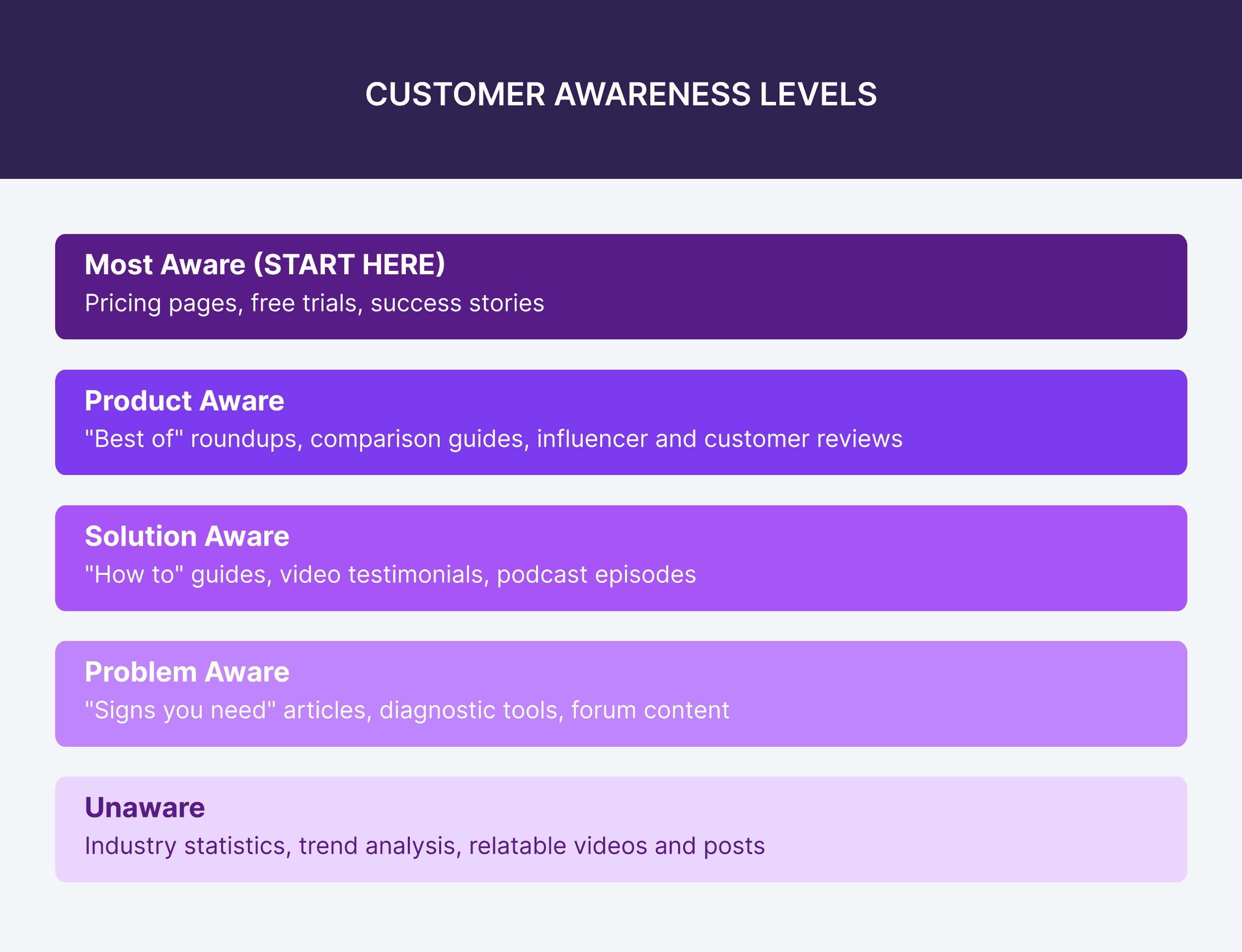
To increase product-level AI visibility, focus on Product Aware and Solution Aware queries.
For Product Aware audiences, create:
- Comparison pages
- “Best alternative” posts
- Owned “best of” lists
Want more ideas?
Talk to your sales team.
Ask them: What features are convincing people to buy? Which competitors are commonly brought up in sales conversations?
Those answers map directly to comparison content AI likes to cite.
For Solution Aware audiences, focus on how-to content that naturally features your product.
For example, when I asked Google’s AI Mode how to reduce background noise from a microphone, it referenced a Descript how-to article.

This same pattern repeats itself across many of Descript’s blog posts: Find a clear problem, give a clear solution, add product mentions naturally.
It’s all about finding the right questions to answer.
To find these opportunities faster, use Semrush’s AI Visibility Toolkit. This data is powered by Semrush’s AI prompt database and clickstream data, organized into meaningful topics.
Head to “Competitor Research” and review:
- Shared topics where competitors appear
- Prompts where they earn more AI visibility than you

Then, dig into the specific questions behind those prompts.

The goal isn’t simply “more content”.
It’s answering the right questions — at the right stage — with content AI can confidently cite.
Building Positive Sentiment With Digital PR and Affiliate Marketing
AI visibility isn’t earned on your website alone.
LLMs look for signals across the web.
This is what we call consensus. And it means that positive sentiment has to exist outside your owned channels.
Descript is doing this in two ways:
- Digital PR on sites AI already trusts
- A creator-friendly affiliate program that drives third-party mentions
Here’s how it works: Google’s AI Mode tends to favor certain websites to source when answering queries about software.
Semrush’s visibility research for AI in SaaS from December 2025 shows these sites dominate citations:
- Zapier
- PCMag
- Gartner
- G2

Here’s what’s interesting.
Descript is mentioned in articles across nearly all of these top sources.
For example, in software listicles like this one on Zapier:

Or in real-world experience articles like this one on Medium:

Or in their clear listings on reviews sites like Gartner and G2:

When AI systems cite those favored sources, Descript comes along for the ride.
Not because it’s the biggest brand.
But because it’s present where AI is already looking.

The second lever is Descript’s affiliate program.
It’s simple:
- $25 per new subscriber
- 30-day attribution window
- Monthly payouts
- No minimums

Those are solid incentives.
And they lead to more creator-driven content across the web.
For example, a YouTube walkthrough from VP Land explains how to use Descript and includes an affiliate link in the description.

When I later asked Google’s AI Mode how to use Descript, that exact video was cited as a source.

That’s the pattern.
Affiliate content creates citable, trusted references that AI systems reuse.
Action Item: Build a Strategy to Get More Mentions Online
Effort vs. Impact: High effort. High impact.
Getting third party mentions is all about building relationships.
First, build relationships with publishers, starting with the ones AI already trusts.
Even if you’re not an enterprise SaaS company with a full-sized PR team, this is still possible.
Granted, it’s not the easy route — but when you find the right websites and perform regular outreach to those teams, you can get your brand on these sites.
Before you start outreach, get your bearings.
Start by going back to Semrush’s AI Visibility Toolkit. Head to the “Competitor Research” tab and select “Sources.”

This shows you:
- Which sites LLMs cite for your category
- Where competitors are already getting mentioned
- Gaps where your brand doesn’t show up (yet)
Those sites become your shortlist.
Outreach works better when you’re aiming at sources AI already relies on.
Second, build relationships with creators.
Affiliate programs work when creators want to talk about you.
So, build an affiliate program people actually want to be part of.
This means the program has to be easy to join, with clear terms that make it worth their time.
At a minimum, make sure you have:
- A simple signup
- Transparent tracking
- Reliable payouts
Pro tip: Use a tool like PartnerStack to handle all of the details automatically. Better signups, better tracking, and automated payouts build trust with your affiliates.
If you need inspiration, research top affiliate programs to learn more about the conditions creators expect.
But most importantly: Treat affiliates as distribution partners, not just a side channel.
This means enabling them with clear positioning on your product, example use cases, demo workflows, screenshots they can reuse, and other resources.
The better you equip them, the stronger their recommendations will be.
Once you have this set up, track the results.
Use AI visibility data to see:
- Which publisher relationships are turning into citations in AI search
- Which creators show up in AI answers
- Which formats perform best
Then, double down.
Now that we’ve discussed what Descript is doing well, let’s look at where there’s room for improvement.
Where Descript Could Improve: Reddit Marketing
Descript is doing a great job in many areas that are important for AI search visibility.
That said, there’s one area they’re missing out on: Reddit.
And yes, Reddit matters. A lot.
It’s still one of the most-cited sources in Google’s AI Mode.
And in almost all of the searches I tested above, Reddit was cited as a source (especially conversations in the r/podcasting subreddit).

Here’s the problem: right now, Reddit is not doing Descript any favors.
Here are a few thread titles I found just by searching for Descript in a podcasting subreddit:

And yes, there are positive mentions of Descript. But they’re buried under a wave of negative sentiment.
When LLMs scan Reddit for sentiment, that unbalance matters.
AI wants to see consensus. So when Reddit skews negative, recommendations may weaken, and alternatives get surfaced instead.
Even when the product is strong.
That’s why, while Descript’s AI visibility is good, it’s still not as good as it could be. And that vulnerability could hurt them in the long run, even if they’re still doing everything else right.
Here are some ways that Descript (and you) could turn the tides on Reddit:
- Avoid promoting and start participating: Reddit punishes marketing language. Helpful, honest comments perform better than posts.
- Respond to criticism directly (when appropriate): Not defensively, but with clear explanations and fixes
- Be present before there’s a problem: Accounts that only show up during damage control don’t build trust
- Focus on comments, not posts: High-value comments in active threads outperform standalone branded posts
- Monitor brand mention weekly: Focus especially on high-intent subreddits. In Descript’s case, that could be r/podcasting.
To be fair, it seems like Descript is taking steps in the right direction.
As of December 2025, the Descript team has taken control of a dedicated brand subreddit, with PMM Gabe at the helm.

And the team’s responses feel very Reddit-friendly, not using marketing jargon or being pushy.

But popular threads here still have very little interaction with the Descript team. And there seems to be very few (if any) comments from the Descript team outside of this branded subreddit.
It’s a step in the right direction, but there’s still a lot to work on.
Done right, Reddit becomes a sentiment stabilizer and a stronger input source for AI answers.
Ignore it, and Reddit can become a liability.
Remember: for AI visibility, silence isn’t neutral.
Further reading: If Reddit feels like a whole other world, we’ve got you covered. Read our full guide to Reddit Marketing.
What You Can Take Away from This SaaS LLM Visibility Case Study
Descript isn’t winning AI visibility because it’s the biggest brand.
It’s winning because it’s clear, focused, and consistently helpful.
None of that is accidental.
And none of it requires massive scale.
You can get started on this today by choosing one key action to work on.
Use the effort vs. impact lens from this article to choose where to start.
- Add in-product screenshots and videos: Low effort, medium impact
- Tighten your niche messaging: Medium effort, high impact
- Build citable MoFu/BoFu content: High effort, medium impact
- Invest in digital PR, affiliates, and community participation: High effort, high impact
- Create seriously helpful content: High effort, high impact

Pick one, start there. AI search visibility tools for SaaS companies — like Semrush’s AI Visibility Toolkit — can help you see exactly where you stand today, and where you can improve.
Remember: LLM visibility isn’t about chasing algorithms.
It’s about making your product easier to understand, easier to trust, and easier to recommend.
Do that consistently — and AI search will follow.
Want to learn how it all works on a deeper level? Read our LLM visibility guide to discover even more ways to increase your brand mentions and citations in AI search.
Backlinko is owned by Semrush. We’re still obsessed with bringing you world-class SEO insights, backed by hands-on experience. Unless otherwise noted, this content was written by either an employee or paid contractor of Semrush Inc.