
AI chat is changing how people shop for fashion — fast.
Before AI, buying something as simple as casual leggings meant typing keywords into Google. Then, sifting through pages of results.
Comparing prices. Reading reviews. Getting overwhelmed.
In fact, 74% of shoppers give up because there’s too much choice, according to research by Business of Fashion and McKinsey.
Now?
A shopper submits a query. AI gives one clear answer — often with direct links to products, reviews, and retailers. They can even click straight to purchase.

So, how do you make sure AI recommends your fashion brand?
We analyzed how fashion brands appear in AI search. And why some brands dominate while others disappear.
In this article, you’ll learn how large language models (LLMs) interpret fashion, what drives visibility, and the levers you can pull to get your brand visible in AI searches (plus a free fashion trend calendar to help you plan).

Note: The data in this article comes from Semrush’s AI Visibility Index, August 2025.
The 3 Types of AI Visibility in Fashion
There are three ways people will see your brand in AI search: brand mentions, citations, and recommendations.
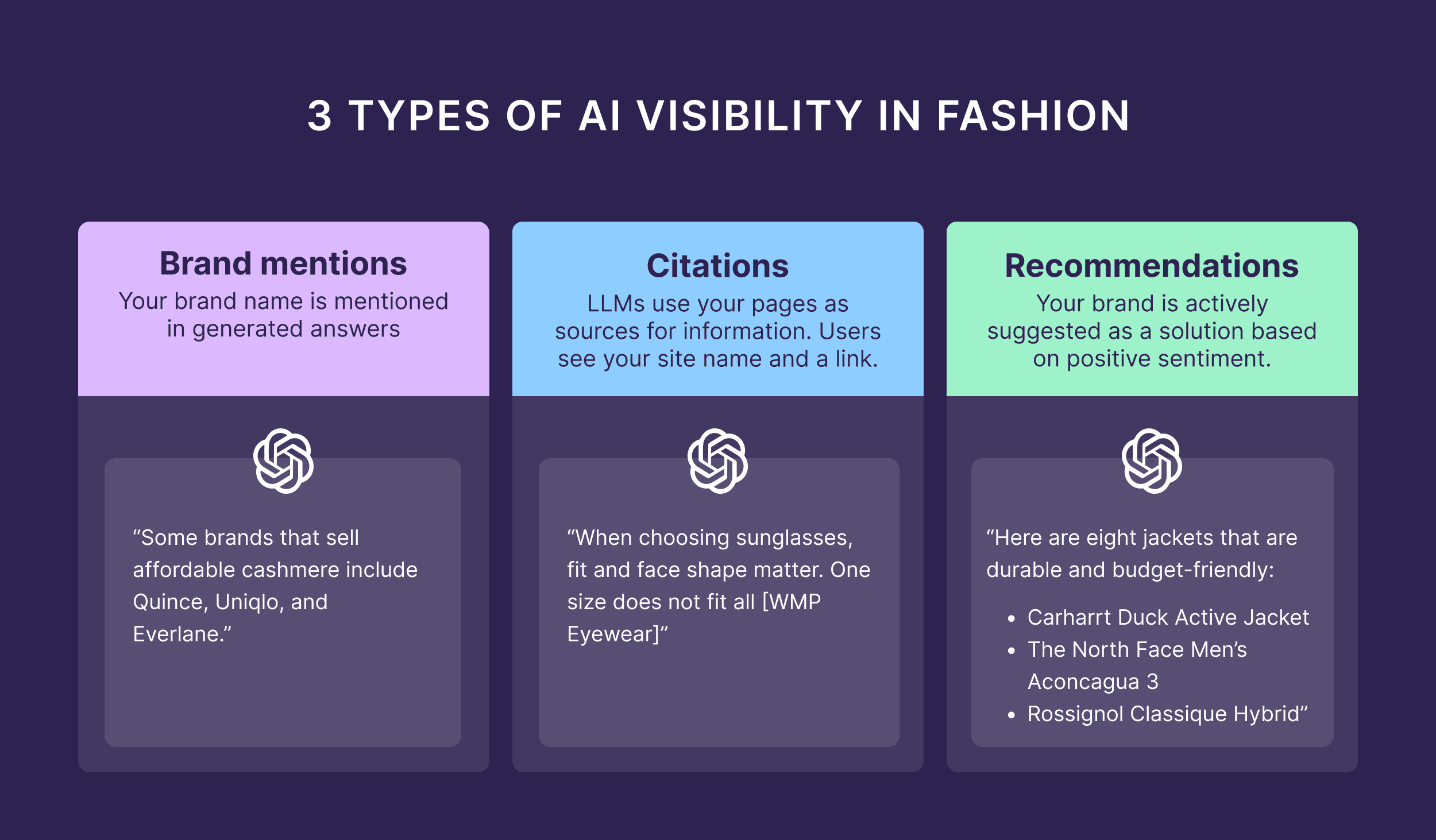
Brand mentions are references to your brand within an answer.
Ask AI about the latest fashion trends, and the answer includes a couple of relevant brands.

Citations are the proof that backs up AI answers. Your brand properties get linked as a source. This could be product pages, sizing guides, or care instructions.
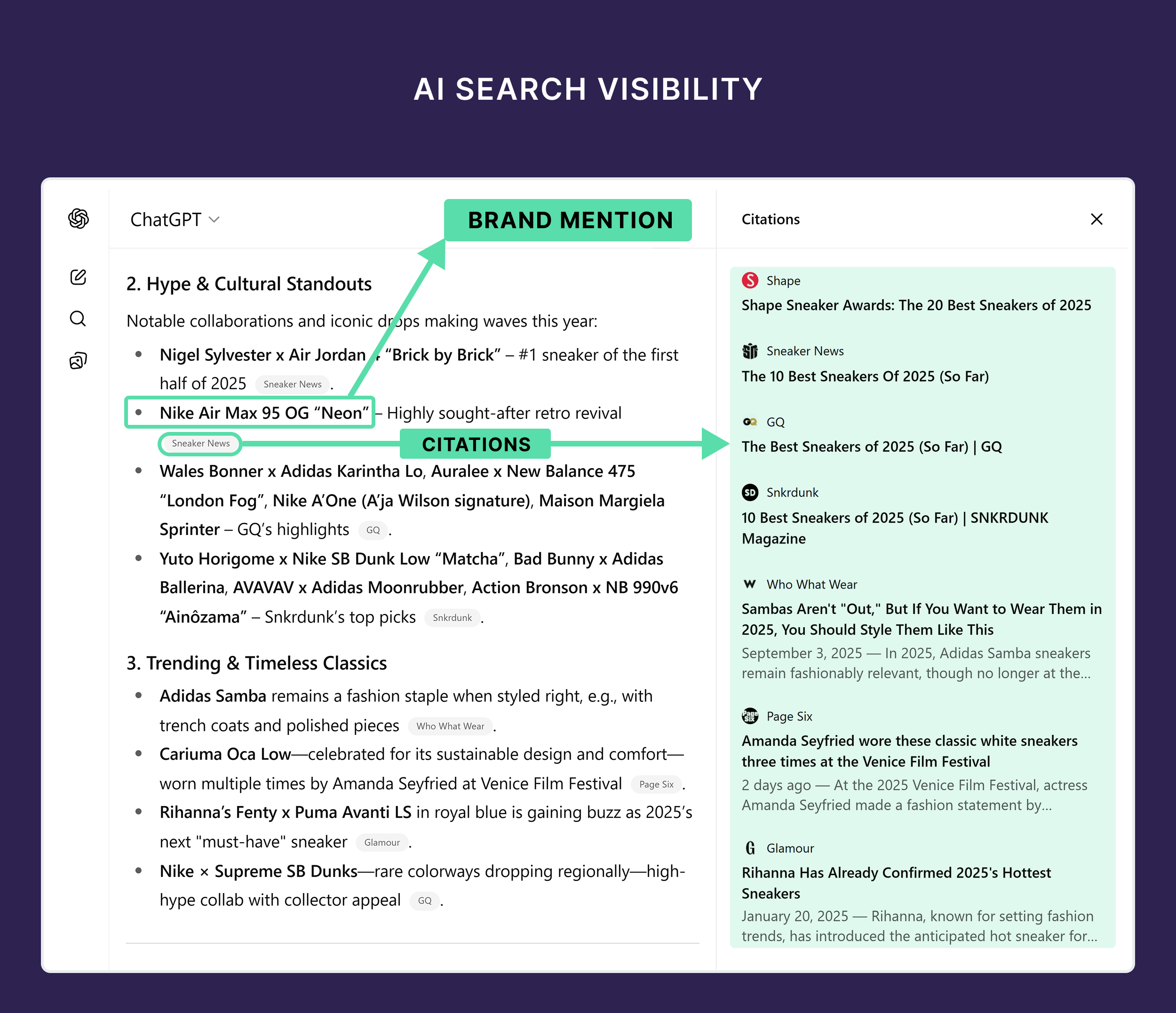
Citations also include other sites that talk about your brand, like Wikipedia, Amazon, or review sites.
Product recommendations are the most powerful form of AI visibility. Your brand isn’t just mentioned; it’s actively suggested when someone is ready to buy.
For example, I asked ChatGPT for recommendations of aviator sunglasses:

Ray-Ban doesn’t just show up as a mention — they’re a recommended option with clickable shopping cards.
How AI Models Choose Which Fashion Brands to Surface
If you’ve ever wondered how AI chooses which fashion brands to surface, here are the two basic factors:
- By evaluating what other people say about you online
- By checking how consistently factual and trustworthy your own information is
Let’s talk about consensus and consistency. Plus, we’ll discuss real fashion brands that are winning at both.
Consensus
If you ask all your friends for their favorite ice cream shop, they’ll probably give different answers.
But if almost everyone coincided in the same answer, you trust that’s probably the best place to go.
AI does something similar.
First, it checks different sources of information online. This includes:
- Editorial websites, like articles in Vogue, Who What Wear, InStyle, and others
- Community and creator content, including TikTok try-ons, Reddit threads, and YouTube product roundups
- Retailer corroboration, like ratings and reviews on Amazon, Nordstrom, Zalando, and more
- Sustainability verification from third parties like B Corp, OEKO-TEX, or Good On You
After analyzing this information, it gives you recommendations for what it perceives to be the best option.
Here’s an example of what that consensus looks like for a real brand:

Carhartt is mentioned all over the web. They appear in retail listings, editorial pieces, and in community discussions.
The result?
They get consistent LLM mentions.

Consistency
AI also judges your brand based on the consistency of your product information.
This includes:
- Naming & colorways: Identical names/color codes across your own site, retailers, and mentions
- Fit & size data: Standardized size charts, fit guides, and model measurements
- Materials & care: The same composition and instructions across all channels
- Imagery/video parity: The same SKU visuals (like hero, 360, try-on) on your site and retailer sites
- Price & availability sync: Real-time updates during drops or restocks to avoid stale or conflicting data
For example, Lululemon does a great job of keeping product availability updated on their website.
If you ask AI where to find a specific product type, it directs you back to the Lululemon website.

This happens because Lululemon’s site provides accurate, up-to-date information.
Plus, it’s consistent across retailer pages.
The Types of Content That Dominate Fashion AI Search
Mentions get you into the conversation. Recommendations make you the answer. Citations build the credibility that supports both.
The brands winning in AI search have all three — here’s how to diagnose where you stand.

Let’s talk about the fashion brands that are consistently showing up in AI search results, and the kind of content that helps them gain AI visibility.
Editorial Shopping Guides and Roundups
Editorial content has a huge impact on results.
Sites like Vogue, Who What Wear, and InStyle are regularly cited by LLMs.

These editorial pieces are key for AI search, since they frame products in context — showing comparison, specific occasions, or trends.
There are two ways to play into this.
First, you can develop relationships with editorial websites relevant to your brand.
Start by researching your top three competitors. Using Google (or a quick AI search), find out which publications have featured those competitors recently.
Then, reach out to the editor or writers at those publications.
If they’re individual creators, you might send sample products for them to review.
Looking for mentions from bigger publications?
You might consider working with a PR team to get your products listed in articles.
To build consistency in that content, provide data sheets with information about material, fit, or care.

Second, you can build your own editorial content.
That’s exactly what Huckberry does:

They regularly produce editorial-style content that answers questions.
Many of these posts include a video as well, giving them more opportunity for discovery in LLMs:

Retailer Product Pages and Brand Stores
Think of your product detail page (PDP) as the source of truth for AI.
If you don’t have all the information there, AI will take its answers from other sources — whether or not they’re accurate.
Product pages (your own website or a retailer’s) need to reflect consistent, accurate information. Then, AI can understand and translate into answers.
Some examples might include:
- Structured sizing information
- Consistent naming and colorways
- Up-to-date prices and availability
- Ratings (with pictures)
- Fit guides (like sizing guides and images with model measurements and sizing)
- Materials and care pages
- Transparent sustainability modules
For example,Everlane provides the typical sizing chart on each of its products. But they take it a step further and include a guide to show how a piece is meant to fit on your body.
You can even see instructions to measure yourself and find the right size.

That’s why, when I ask AI to help me pick the right size for a pair of pants, it gives me a clear answer.
And the citations come straight from Everlane’s website.

Everlane’s product pages also include model measurements and sizing.
So when I ask ChatGPT for pictures to help me pick the right size, I get this response:

However you choose to present this information on your product pages, just remember: It needs to be identical on all retailer pages as well.
Otherwise, your brand could confuse the LLMs.
User Generated Video Content
What you say about your own brand is one thing.
But what other people say about you online can have a huge influence on your AI mentions.
Of course, you don’t have full control over what consumers post about you online.
So, proactively build connections with creators. Or, try to join the conversation online when appropriate.
This can help you build a positive sentiment toward your brand, which AI will pick up on.
Not sure which creators to work with?
Try searching for your competitors on channels like TikTok or Instagram. See which creators are mentioning their products, and getting engagement.
You can also use tools like Semrush’s Influencer Analytics app to discover influencers.
Search by social channels, and filter by things like follower count, location, and pricing.

Here’s an example: Aritzia has grown a lot on TikTok. They show up in creator videos, fit checks, and unboxing-style videos.
In fact, the hashtag #aritziahaul has a total of 32k posts, racking up 561 million views overall.

Other fashion brands, like Quince, include a reviewing system on their PDPs.
This allows consumers to rate the fit and add pictures of themselves wearing the product.
LLMs also use this information to answer questions.

Creator try-ons, styling videos, and similar content can help increase brand mentions in “best for [body type]” or “best for [occasion]” prompts.

Pro tip: Zero-click shopping is coming. Perplexity’s “Buy with Pro” and ChatGPT’s “Instant Checkout” hint at a future where AI answers lead straight to one-click purchases. The effects are still emerging, but as with social shopping, visibility wins. So, make sure your brand shows up in the chats that drive buying decisions.
Reddit and Community Threads
Reddit is a major source of information for fashion AI queries.
This includes information about real-world fit, durability, comfort, return experiences, and comparisons.
For example, Uniqlo shows up regularly in Reddit threads and questions about style.

You can also find real reviews of durability about the products.

As a result, the brand is getting thousands of mentions in LLMs based on Reddit citations.
Plus, this leads to a ton of organic traffic back to the Uniqlo website.

Obviously, it’s impossible to completely control the conversation around your brand. So for this to work, there’s one key thing you can’t miss:
Your products need to be truly excellent.
A mediocre product that has a lot of negative sentiment online won’t show up in AI search results.
And no amount of marketing tactics can fool the LLMs.

Further reading: Learn how to join the conversation online with our Reddit Marketing guide.
Lab Tests and Fabric Explainers
This kind of content shows the quality of your products.
It gives LLMs a measurable benchmark to quote on things like pilling or color fastness.
This content could include:
- “6-month wear” style videos
- Pages that explain the fabrics and materials used
- Third party tests
- Clear care instructions
For example, Quince has an entire page on their website talking about cashmere.

And in Semrush’s AI Visibility dashboard, you can see this page is one of the top cited sources from Quince’s website.

Another option is to create content that shows tests of your products.
Here’s a great example from a brand that makes running soles, Vibram.
They sponsored pro trail runner Robyn Lesh, and teamed up with Huckberry to lab test some of their shoes.

This kind of content is helping Vibram maintain solid AI visibility.

And for smaller brands who don’t have Vibram’s sponsorship budget?
Try doing product testing content with your own team.
For example, have a team member wear a specific product every day for a month, and report back on durability.
Or, bury a piece of clothing underground and watch how long it takes to decompose, like Woolmark did:

Get creative, and you’ll have some fun creating content that can also help your brand be more visible.
Want to check your brand’s AI visibility?
Try the AI Visibility Toolkit from Semrush to see where your brand stands in AI search, and learn how to optimize.
Start by checking your AI visibility score. You’ll see how this measures up against the industry benchmarks.

You can prioritize next steps based on the Topic Opportunities tab.
There, you’ll see topics where your competitors are being mentioned, but your brand is missed.

Then, jump to the Brand Perception tab to learn more about your Share of Voice and Sentiment in AI search results.
You’ll also get some clear insights on improvements you can make.

Comparisons and Alternatives Content
AI loves a good comparison post (and honestly, who doesn’t?). So, creating content that compares your products to other brands is a great way to get more mentions.
This is part of LLM seeding.
It helps you get brand exposure without depending on organic traffic dependence. Plus, it helps level the playing field with bigger competitors.

For instance, Quince is often cited online as a cheaper alternative to luxury clothing.
I asked ChatGPT for affordable cashmere options, and Quince was the first recommendation.

So, why is this brand showing up consistently?
One reason is their comparison content.
In each PDP, you’ll see the “Beyond Compare” box, showing specific points of comparison with major competitors.

The right comparisons are handled honestly and tastefully.
Focus on real points of difference (like Quince does with price). Or, show which products are best for certain occasions.
For example: “Our sweaters are great for hiking in the snow. Our competitors’ sweaters are better for indoor activities.”
Comparisons give AI a reason to recommend your fashion brand when someone asks for an alternative.
What This Shift Means for Your Fashion Brand
AI search has changed the way people discover products, and even their path to purchase.
Before, this involved multiple searches, clicking on different websites, or scrolling through forums. Now, you can do this in one simple interface.
So, how is AI changing fashion, and how can your brand adapt?
Editorial, Retailer, and PDP Split
AI search doesn’t treat every source of information equally.
And depending on which model your audience uses, the “default” source of truth can look very different.
ChatGPT leans heavily on editorial and community signals.
It rewards cultural traction — what people are talking about, buying, and loving.
For example, articles like this one from Vogue are a prime source for ChatGPT answers:

Meanwhile, Google’s AI Mode and Perplexity skew toward retailer PDPs.
They look for structured data like price, availability, or fit guides. In other words, they trust whoever has the cleanest, richest product data.
The most visible brands win in both arenas: cultural conversation and PDP completeness.
Here’s What You Can Do
To show up in all major LLMs, you need two parallel pipelines.
- Cultural traction: Like press mentions, creator partnerships, and community visibility
- Citation-ready proof: For example, complete and accurate PDPs across retailer channels
Here’s an Example: Carhartt
Carhartt is a great example of a brand that’s winning on both sides.
First, they get consistent cultural visibility.
For instance, Vogue reported that the Carhartt WIP Detroit jacket made Lyst’s “hottest product” list. That led to searches for their brand increasing by 410%.
This makes it more likely for LLMs to recommend their products in answers:

This is the kind of loop that works wonders for a fashion brand.

At the same time, Carhartt is also stocked across a huge range of retailers. You can find them in REI, Nordstrom, Amazon, and Dick’s, plus their own direct-to-consumer website.
So, Google AI Mode has an abundance of PDPs, videos, reviews, and Q&A to cite.
This makes Carhartt extremely “citation-friendly” in both models.
No wonder it has such a strong AI visibility score.

Trend Shocks and Seasonal Volatility
Trend cycles aren’t a new challenge in the fashion industry. But it becomes a bigger challenge to maintain visibility when those trends affect which brands appear in AI search.
Micro-trends pop up all the time, triggering quick shifts in how AI answers fashion queries.
When the trend heats up, LLMs pull in brands that appear online in listicles or TikTok roundups.

And when the trend cools? Those same brands disappear just as quickly.
Here’s What You Can Do
To stay present during each trend swing, you need a content and operations pipeline that speaks in real time to the language models are echoing.
- Build a proactive trend calendar: Map your content to seasonal moments, like spring tailoring, fall layers, holiday capsules, back-to-school basics, and so on
- Refresh imagery and copy to mirror trend language: Update PDPs, on-site copy, and retailer description to match the phrasing used in cultural content
- Create rapid-fire listicles and lookbooks: Listicle-style content, creator videos, and other trend-related mentions can help boost visibility. This includes building your own content and working with creators and publications to feature your product in their content.
Download our Trend Calendar for Fashion Brands to plan ahead for upcoming trends and create content that matches.
Here’s an Example: UGG
Anyone who was around for Y2K may have been shocked to see UGG boots come around again.
But the brand was ready to jump onto the trend and make the most of their moment.
Vogue reported that UGG made Lyst’s “hottest products” list in 2024.
Since then, they’ve been regularly featured in seasonal “winter wardrobe essentials” style roundups.
One analyst found that there had been a 280% increase in popularity for the shoes. Funny enough, that trend seems to be a regular occurrence every year once “UGG season” rolls around.
In fact, on TikTok, the hashtag #uggseason has almost 70k videos.

UGG stays visible even as seasons trends shift. That’s because the brand is always present in the content streams that LLMs treat as cultural indicators. By partnering with influencers, UGG amplified its presence so effectively that the boots themselves became a moment — something people wanted to photograph, share, and join in on without being asked.
The result?
They have one of the highest AI Visibility scores I saw while researching this article.

(As a marketer, I find this encouraging. As a Millennial, I find it deeply disturbing.)
Pro tip: Want to measure the results? Track how often your brand or SKUs appear in new listicles per month, plus how they rank in those roundups. Then use Semrush’s AI Visibility Toolkit to track your brand’s visibility using trend-related prompts.
Sustainability and Proof (Not Claims)
Sustainability has become one of the strongest differentiators for fashion brands in AI search.
But only when brands back it up with verifiable proof.
LLMs don’t reward vague eco-friendly language. Instead, they surface brands with certifications, documentation, and third-party validation.
Models also pull heavily from Wikipedia and third-party certification databases. These pages often act as trust anchors for AI search results.
Here’s What You Can Do
You need to build a clear, credible footprint that models can cite.
- Centralize pages on materials, care, and impact: Make them brief, structured, and verifiable. Include materials, sourcing, certifications, and repair/resale info.
- Maintain third-party profiles: Keep your certifications up-to-date. This includes things like Fair Trade, Bluesign, B-Corp, GOTs, etc.
- Standardize sustainability claims across all retailers: If your DTC site says “Fair Trade Certified” but your Nordstrom PDP doesn’t? Models treat that as unreliable.
Here’s an Example: Patagonia
Patagonia is the ruler of AI visibility with a 21.96% share of voice.

In part, this is because of their incredible dedication to sustainability. They basically own this niche category within fashion.
Patagonia’s sustainability claims are backed up by third-party certifications.
And they’re displayed proudly on each PDP.

They’re also transparent about their efforts to help the environment.
They keep pages like this updated regularly.

These sustainable efforts aren’t just big talk.
Review sites and actual consumers speak positively online about these efforts.

They’ve made their claim as a sustainable fashion brand.
So, Patagonia shows up first, almost always, in LLMs when talking about sustainable fashion:

That’s the power of building a sustainable brand.
Make AI Work for Your Fashion Brand
You’ve seen how the top fashion brands earn AI visibility.
The path forward is simple: Consensus + Consistency.
Build consensus by getting people talking: Create shareable content, encourage customer posts, or work with creators and publications.
Build consistency by keeping your product info aligned across your site and retail partners.
To get started, download our Fashion Trend Content Calendar to plan your strategy around seasonal trends.
Want to go deeper? Check out our complete guide to AI Optimization.
Backlinko is owned by Semrush. We’re still obsessed with bringing you world-class SEO insights, backed by hands-on experience. Unless otherwise noted, this content was written by either an employee or paid contractor of Semrush Inc.