6 Best Enterprise SEO Tools for Optimizing at Scale

Written by Yongi Barnard
At the enterprise level, you need an SEO tool that does more than just handle basic keyword research and quick site health checks.
You need analytics at scale. Site crawling for thousands (or millions) of pages. And automations that actually work to improve rankings and AI visibility.
And you need all of this in a package that your team can pick up without taking a month off to learn how to use.
Standard SEO platforms simply won’t cut it. That’s why I’ve put together a list of the best enterprise SEO tools to help you optimize at scale.
Before you choose a tool, you need to first understand what kind of SEO problem you’re trying to solve.
We’ve categorized the following tools by the main problems they solve, so you can choose the right enterprise SEO tool for your situation.
| SEO Problem | Best Tool | Why |
|---|---|---|
| Need one platform for everything | Semrush for Enterprise | Semrush for Enterprise covers keyword research at scale, technical auditing for millions of pages, content optimization, AI visibility tracking, and custom reporting, all in one platform |
| SEO automation and implementation at scale | seoClarity | seoClarity lets your team deploy on-page changes, automate internal linking, and run split tests directly — without waiting on engineering every time |
| Proving ROI and stakeholder reporting | BrightEdge | BrightEdge’s executive-ready dashboards connect SEO performance to revenue, and its historical data lets you show trends over time |
| Content optimization and editorial velocity | Conductor | Conductor helps content teams prioritize what to create, optimize existing pages with AI-driven recommendations, and coordinate work across large, distributed teams |
| Performing technical SEO at scale | Botify | Botify crawls millions of URLs, connects to your server logs, and shows exactly which pages search engines can and can’t reach |
| Managing local brand presence across markets and locations | Yext | Yext keeps your business information consistent across 200+ directories simultaneously, so your enterprise brand shows up accurately whether someone searches on Google, Apple Maps, or anywhere else |
Let’s go through each of these tools in more detail.
1. Semrush for Enterprise
Best for: All-in-one brand visibility everywhere your audience searches

Main use case: Semrush for Enterprise is built for organizations managing thousands or even millions of pages across multiple markets, teams, and languages. It covers traditional search performance, AI search visibility, technical site health, and competitive intelligence.

Brands like Salesforce, TikTok, Samsung, Hertz, and ZoomInfo all use Semrush for Enterprise.
Where the data comes from: Semrush’s proprietary databases — 28B+ keywords, 43T+ backlinks, 239M+ prompts, and 800M+ domains — connect directly with tools like GA4, Google Search Console, and Google Ads.
How reporting works: Custom dashboards can be tailored by role, and they can be shared as needed (anyone can access them in a “viewer” role). The reports are customizable to match your goals and report in whatever way your stakeholders prefer.

Track Performance Across Traditional Search and AI
Your customers are finding brands through traditional Google search, but also through AI Overviews, AI Mode, ChatGPT, Perplexity, Gemini, Grok, and Microsoft Copilot.
Semrush for Enterprise gives you a single view of how your brand is performing across all these platforms.
On the SEO side, the performance dashboard shows you which keywords are gaining or losing traffic and which pages need attention.

On the AI side, the Enterprise AI Optimization (AIO) tool tracks your brand’s mentions, citations, and sentiment across major AI platforms. It draws from a database of 213M+ LLM prompts to help you understand where your brand is missing visibility in key conversations your customers are having with AI tools.

“70% higher AI visibility flowed into 50% more bookings from AI referrals, validating our strategy. AIO enabled us to establish ourselves as a leader in a channel that’s becoming core to travel planning.”
Automate SEO at Scale
Semrush for Enterprise automates data-intensive workflows that would otherwise require significant manual effort.
The Link Recommender tool is a good example: Picsart used this feature to implement over 50,000 contextual links across 300+ pages — a process that previously took 15–30 minutes per link manually — in under a week.
The result was a 20% increase in clicks and 124% growth in impressions.

Optimize Content for Search and AI
When you have thousands or millions of pages on a site, it can seem like an impossible task to optimize them all for both search and AI.
But Semrush identifies which pages need optimization and tells you exactly what to change — at the keyword level and across clusters. You’ll see content relevance scores, related keywords to include, and how your existing content stacks up against competitors.
This saves you time and gives your team confidence that they’re actually making the right optimizations based on real data.

Content optimization now extends to AI search too: Semrush for Enterprise can audit for AI visibility gaps and surface prioritized recommendations to improve how and how often you show up in AI responses to your customers’ queries.
The tool gives you live content scoring based on SEO and AI optimization best practices right within the content editor. This way, you get recommendations as you write, all actionable within a few clicks.
Note: Teams can add unlimited writers to the Semrush for Enterprise platform. So freelancers can immediately scale up content production whenever you need (e.g., entering a new market, new product launches, or translating content to new languages).
Pricing
Semrush for Enterprise pricing is customized to your specific business’s needs. Request a demo to learn more.

Not ready for Enterprise? Semrush One gives you access to huge keyword, backlink, and prompt databases, along with site audit tools, rank tracking, and competitive research. Try it for 14 days free.
2. seoClarity
Best for: Getting SEO fixes implemented without a dev queue

Main use case: Enterprise SEO teams rarely struggle to find issues. The bottleneck is getting them fixed. seoClarity’s Clarity Automate suite lets SEO teams deploy on-page changes, implement internal links, update schema, and run split tests directly.
All without a developer involved for every change.
Enterprises like Petco, SpareFoot, and Dell use seoClarity.
Where the data comes from: seoClarity’s proprietary ranking database offers unlimited rank tracking with no keyword caps — useful when monitoring large portfolios across multiple regions.

It also integrates with GSC, GA4, Adobe Analytics, and feeds into BI tools via API for custom reporting.
How reporting works: Customizable dashboards can be segmented by team, market, or business unit. The analytics layer connects rankings and traffic directly to business impact.
Implement SEO Changes Without Engineering
seoClarity’s ClarityAutomate is a suite of execution tools that lets SEO teams act on their findings directly:
- Page Optimizer: Fix on-page issues and deploy changes across URLs without touching the CMS
- Link Seeker: Surface internal linking opportunities and implement them at scale
- Schema Optimizer: Build, test, and deploy schema markup without developer involvement
- SEO Split Tester: Run statistically valid A/B tests on SEO changes before rolling them out site-wide
- Bot Optimizer: Ensure AI search crawlers can access your pages, not just Google
The “if this, then that” automation logic means you can set conditions and let the platform act — or review changes before deploying in bulk.

Either way, your team keeps moving.

Track and Optimize Your Brand’s Presence in AI Search
Clarity ArcAI tracks brand citations and mentions across major AI search platforms.

It also monitors AI bot activity to see which pages AI crawlers are accessing.
Clarity ArcAI can also analyze the sentiment of how your brand is described in AI responses, and surface content optimization recommendations to improve AI visibility.
Pricing

seoClarity’s Enterprise plan starts at $4,500 per month.
3. BrightEdge
Best for: Proving ROI and stakeholder reporting

Main use case: The question BrightEdge is built to answer: how do you show your CMO that SEO is generating revenue, not just rankings?
This enterprise SEO software suite is used by Fortune 100 companies like Visa, Intuit, and Microsoft, thanks in large part to how it handles executive reporting and performance measurement at scale.
Where the data comes from: BrightEdge’s DataMind engine covers tens of billions of keywords. It also integrates directly with Google Analytics, Adobe Analytics, and GSC — so reporting draws on your actual traffic and conversion data, not just estimated SEO metrics.
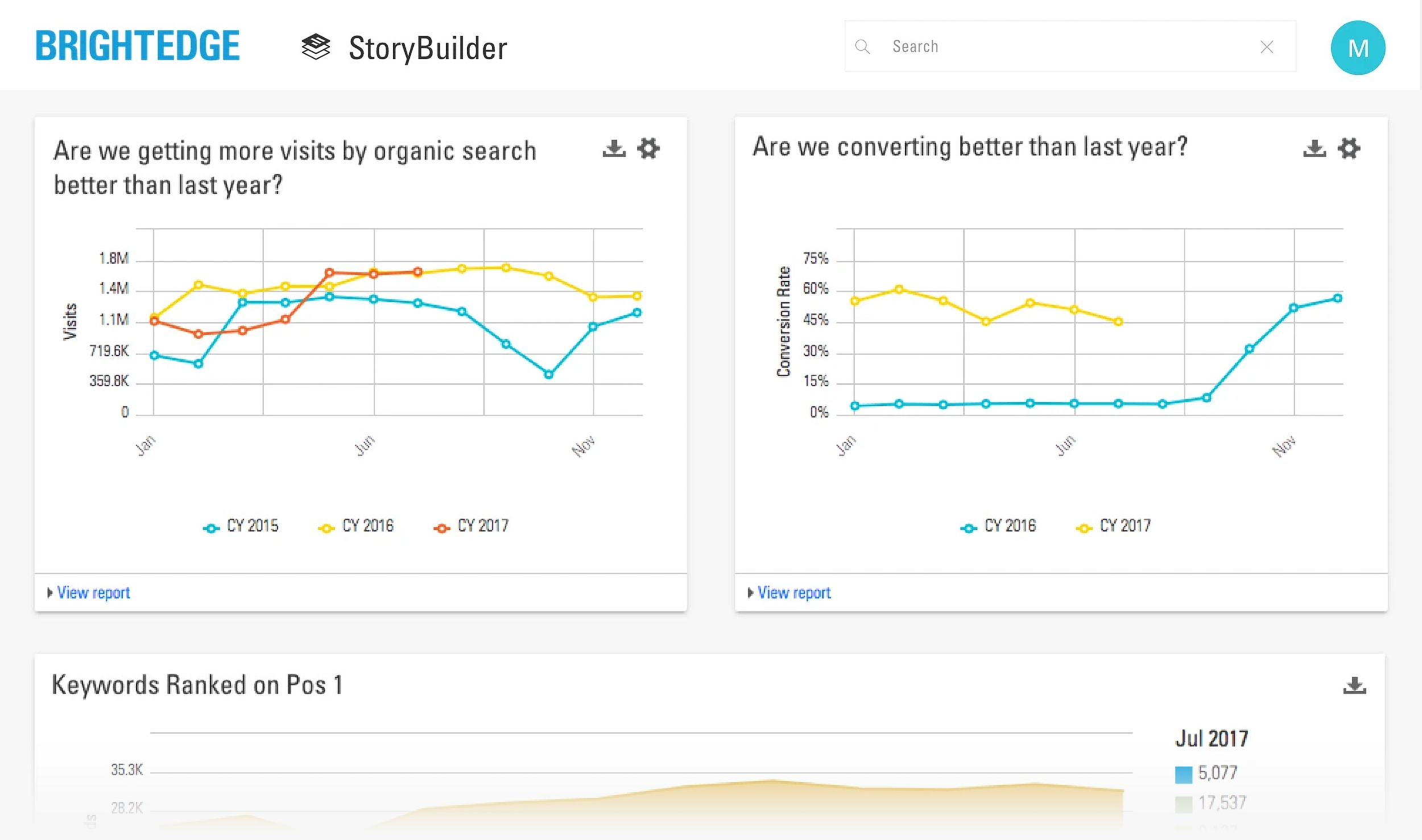
How reporting works: StoryBuilder is BrightEdge’s executive reporting tool. It blends search data, web analytics, and BrightEdge’s proprietary insights into dashboards tailored for different audiences — from detailed keyword reports for your SEO team to revenue impact views for leadership.
This helps teams make the business case for continued SEO investment.
Connect SEO Performance to Business Outcomes
Most enterprise SEO teams have the same problem when it comes to content performance: they can show keyword rankings, but they struggle to show what those rankings are actually worth.
BrightEdge’s StoryBuilder is built specifically to close that gap, by connecting your organic search work to revenue growth.
Key capabilities include:
- Tracking traffic, conversions, and revenue tied to organic search performance
- Building executive dashboards with custom views
- Scheduling automated report delivery so stakeholders get updates without anyone needing to pull data manually
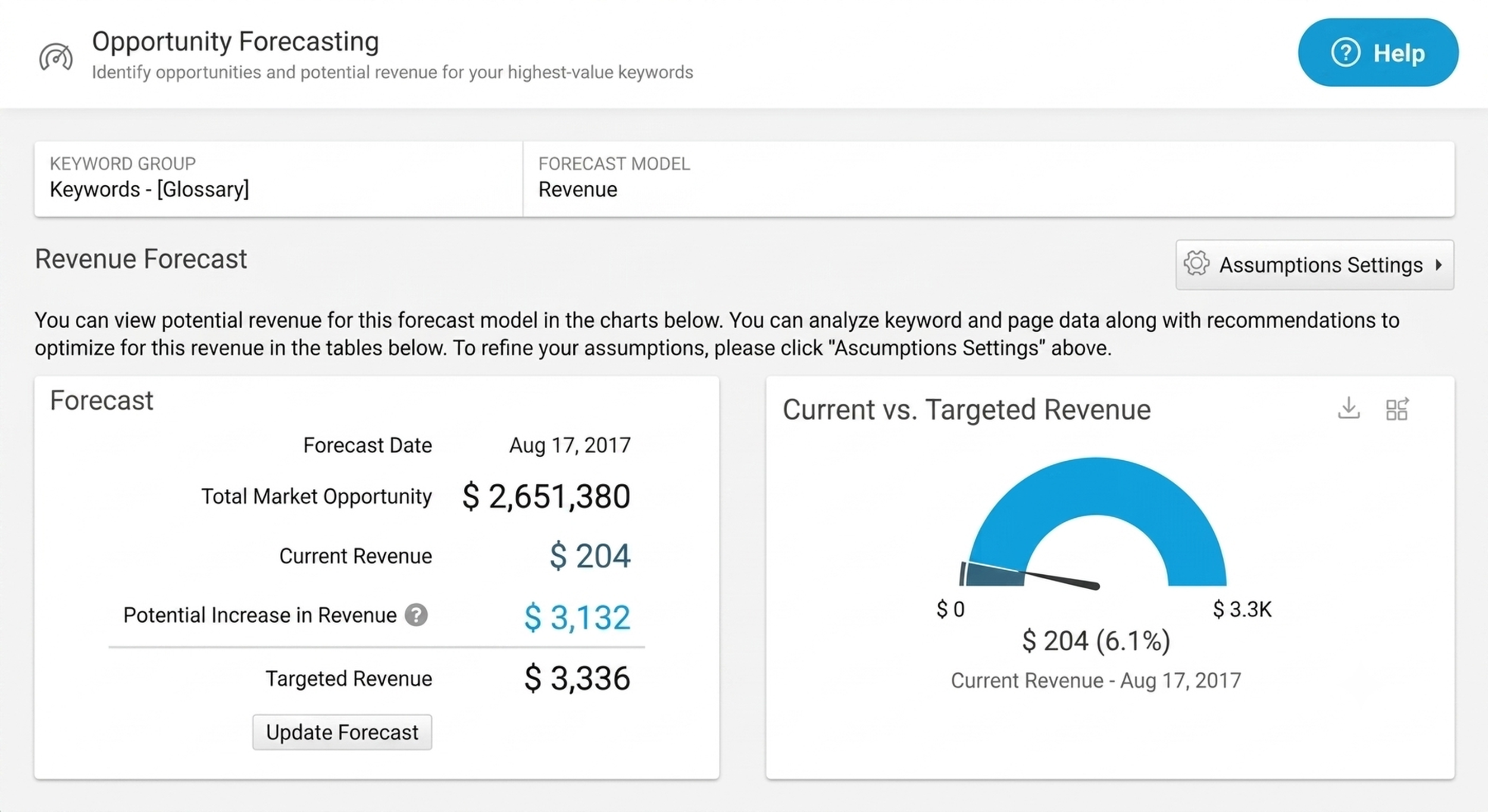
Search Opportunity Forecasting lets teams model the revenue impact of proposed SEO initiatives. So, instead of presenting rankings to a CFO, you can show projected business outcomes backed by real data.
This is particularly useful when making the case for budget allocation.
Use AI to Optimize for Traditional Search and AI Platforms
BrightEdge has built its AI capabilities around two connected tools: Copilot and AI Catalyst.
Copilot is BrightEdge’s AI assistant for content teams. It works through BrightEdge’s search database (Data Cube) to identify what your target audience is searching for.
Then, it helps generate content briefs, structured outlines, and first drafts built around those insights.

AI Catalyst extends this to AI search. It tracks how your brand appears — and how it’s described — across Google’s AI Overviews, ChatGPT, and Perplexity. And you can see it all in one dashboard.

Coordinate Global Teams Without Losing Visibility
The BrightEdge Recommendations tool gives you detailed SEO recommendations to improve your site’s visibility and performance in search results.
Assign these fixes to team members across the globe and then track progress within the tool.

Because every fix is tracked within the platform, leadership always has an up-to-date view of what’s been implemented, what’s pending, and what impact it’s had.
Pricing
Contact BrightEdge for a demo and quote.
4. Conductor
Best for: Content optimization and editorial velocity

Main use case: Conductor connects research, content creation, optimization, and measurement in a single workflow. So the gap between “what to create” and “what’s live on the site” closes faster.
Brands like Verizon, Adidas, and American Express use Conductor.
Where the data comes from: Conductor Intelligence draws on petabytes of search data across traditional and AI search, combined with your own website analytics, Google Search Console data, and technical health signals.
It integrates with GA4, Adobe Analytics, and GSC, and feeds into BI tools via the Conductor Data product.
How reporting works: Conductor ties AI visibility, search performance, and website analytics together in one view, so teams can show how organic efforts are contributing to conversions and revenue. Reports are configurable by team, region, or business unit.
Create Content That Performs in Traditional and AI Search
Conductor Creator is for enterprise teams that need to produce content at scale without sacrificing quality or brand consistency.
First, the AI Topic Map clusters your existing content by topical authority and gives you an idea of how LLMs likely currently map your website.
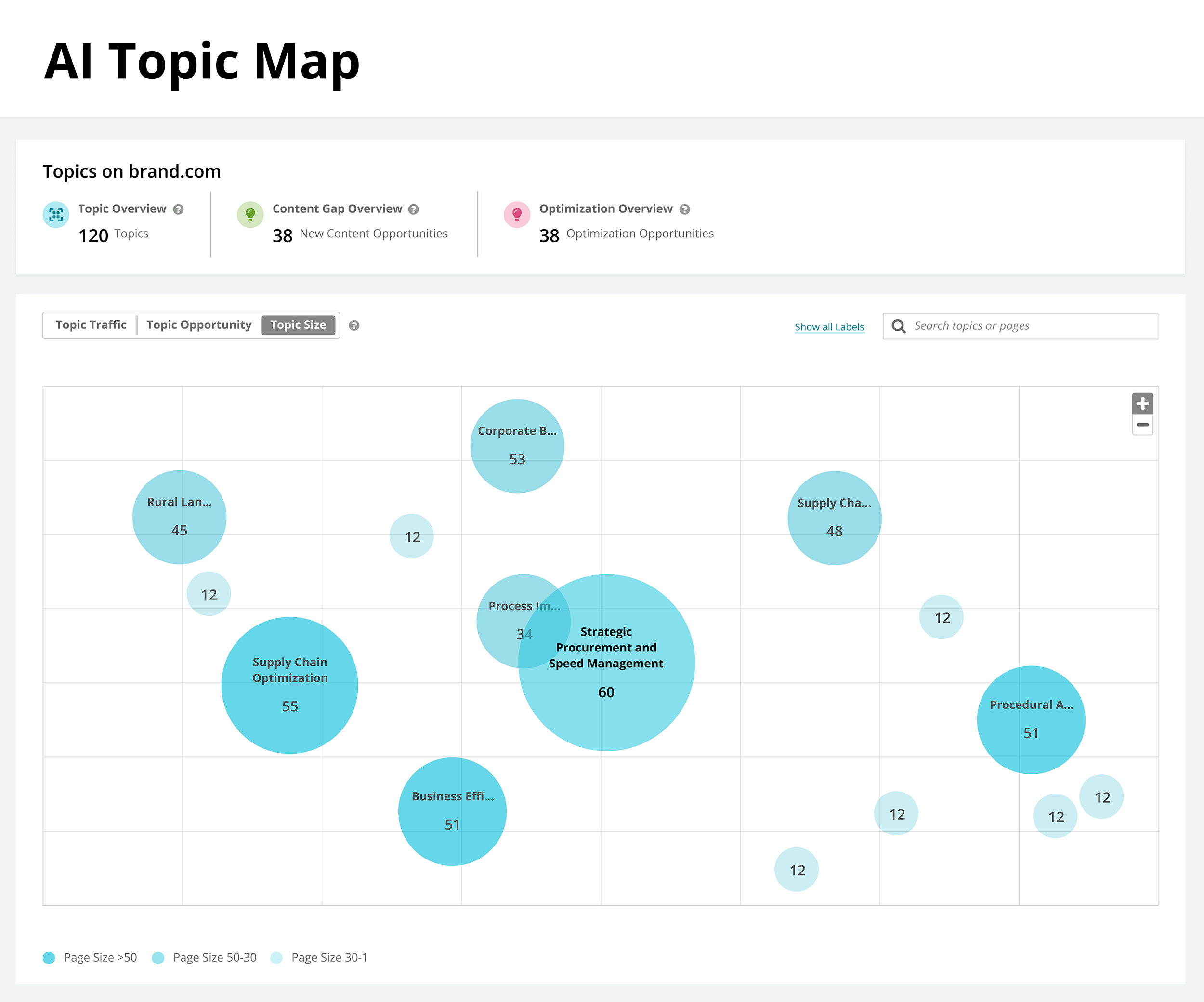
From there, the Writing Assistant generates full content drafts, informed by real-time search data, competitor performance, and your own content goals.

Every draft is evaluated through the Content Score, which automatically assesses quality across SEO best practices, AI optimization criteria, and topical alignment.

So you know before publishing whether a piece is optimized for both traditional search engines and AI.
Monitor Website Performance 24/7
Conductor Monitoring watches your site continuously — flagging issues the moment they happen rather than waiting for the next scheduled crawl.

It detects critical issues like non-indexable pages, changes in canonical links, and drops in content engagement.

Real-time alerts allow you to fix the problems before they impact your search engine rankings or user experience. This is great for enterprise teams that might otherwise struggle to continuously monitor thousands of pages.
Pricing
Conductor offers a three-week free trial, and pricing is available upon request.
5. Botify
Best for: Performing technical SEO at scale

Main use case: When your site has hundreds of thousands — or millions — of pages, traditional technical SEO tools start to break down.
Pages go unindexed, crawl budgets get wasted on low-value URLs, and JavaScript rendering issues hide entire sections of your site from search engines.
Botify is built specifically for this scale of technical complexity. Notable enterprise clients include Levi’s, L’Oréal, and Expedia.
Where the data comes from: Botify Analytics unifies first-part crawl data, server log files, Google Search Console data, and competitive insights.
That gives teams over 1,000 metrics per URL.
Botify also integrates with GA4, Adobe Analytics, and Semrush data.
How reporting works: Reports can be customized and shared across SEO, engineering, and product teams. And because Botify connects technical findings to traffic and revenue impact, it’s easier to make the business case for fixing issues.
Run Comprehensive Technical Audits
Botify Analytics lets you customize your crawls to your enterprise sites’ needs. It offers:
- Unlimited crawl budget capacity
- Processing power to handle up to 50 million URLs per crawl
- Over 1,000 unique data points per URL

Botify Analytics can identify indexing issues, manage site migrations, and surface orphan pages, even within complex site architecture.

The platform aggregates findings into easy-to-understand reports your engineering team can act on directly.
Turn Findings into Fixes Without the Dev Queue
Finding a technical issue is one thing. Fixing it on a million-page site without getting a developer involved for every change is another.
Botify helps you find and fix issues through two layers: Botify Intelligence for recommendations, and Botify Activation for implementation.
Botify Intelligence monitors your site continuously, surfaces early warnings before issues impact rankings, and delivers prioritized recommendations to the right team.
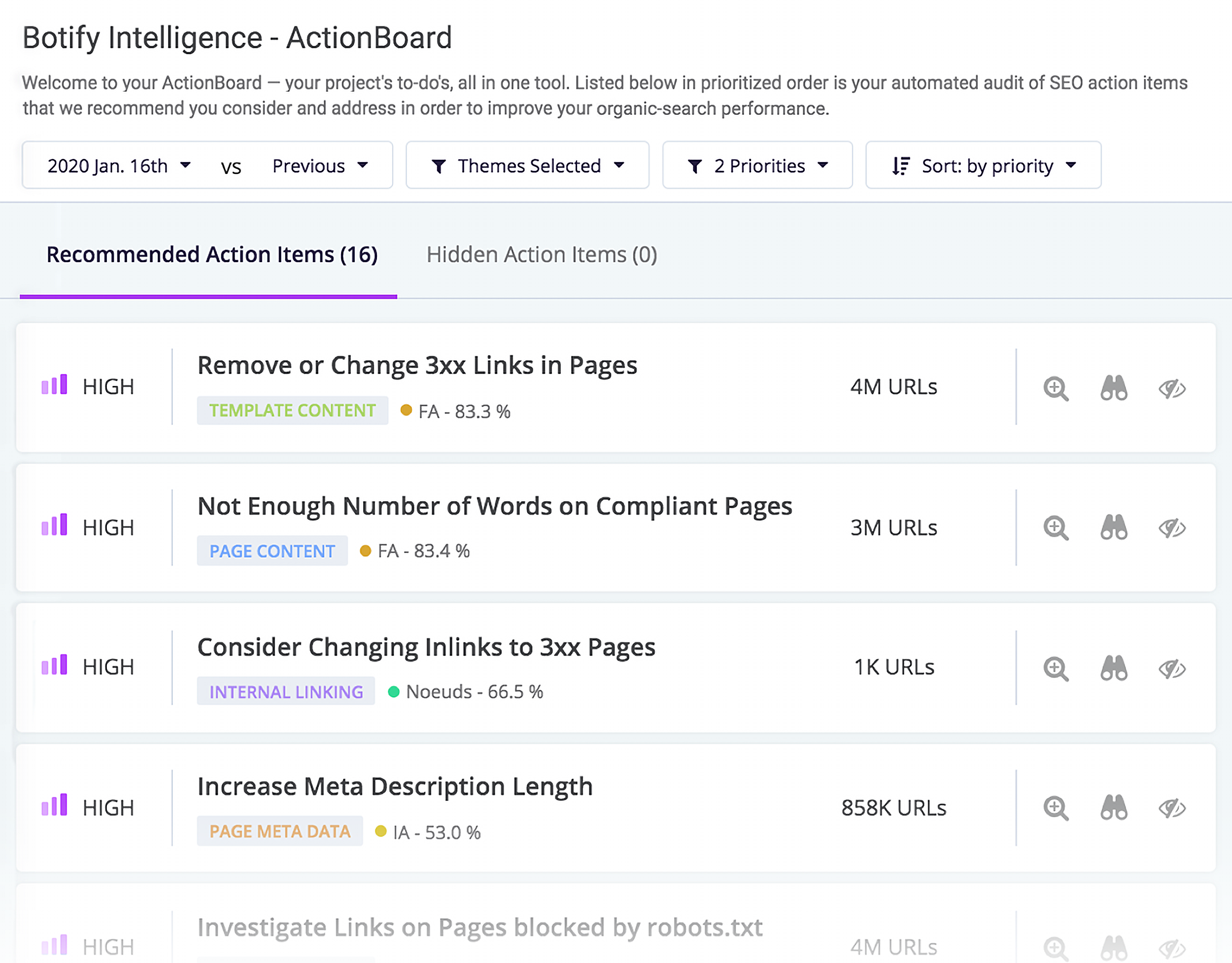
Botify Activation is where those recommendations get implemented at scale, without a developer queue. It includes five tools:
- PageWorkers: Deploy on-page changes across any number of pages
- SmartContent: AI-generated content elements at scale
- SmartIndex: Push priority content directly into search and AI platform indexes
- SpeedWorkers: AI bot management
- SmartLink: Automated internal linking at scale

Between the Intelligence and Activation layers sits Botify Assist — an AI co-pilot that lets teams interact with all of Botify’s data through a conversational interface.
Instead of navigating reports manually, you can ask Assist to diagnose why a page isn’t indexed, identify which issues affect the most URLs, or generate a content brief from trending topic data.

Botify Assist uses its own data to give you clear answers. But you can also connect other tools via MCP — like Google Drive, Jira, Slack, or Github — to get even more well-rounded advice, or even take action.
Track Your Brand’s Visibility in AI Search
In 2025, Botify added AI Visibility — a solution within Botify Analytics.
It tracks how your brand surfaces across ChatGPT, Perplexity, Google AI Mode, AI Overviews, and Gemini.
You’ll see visibility, share of voice, sentiment, and citations tied back to the same crawl and log data Botify already uses.

Botify also expanded its AI bot tracking to cover 12+ new AI crawlers, including OpenAI and Perplexity bots.
Pricing
Botify pricing is customized based on your organization’s size and needs.
6. Yext
Best for: Managing brand presence across markets and locations

Main use case: Yext is built for enterprises managing brand presence across dozens, hundreds, or thousands of physical locations.
Yext keeps business information — hours, addresses, services, phone numbers — accurate and synchronized across 200+ publishers simultaneously. Clients include Domino’s, IHG Hotels & Resorts, FedEx, and Samsung.
Where the data comes from: Yext’s Knowledge Graph is a structured database of your brand’s information that feeds all connected publishers.

Because Yext has direct API connections to 200+ platforms (rather than scraping or submitting to intermediaries), updates go live immediately. This includes traditional directories like Google Business Profile, Apple Maps, and Yelp, as well as AI platforms.
How reporting works: Yext Analytics tracks impressions, clicks, calls, and directions by publisher or location. So teams can see which directories are actually driving customer actions.

Manage Multiple Online Listings
Enter your business data and Yext automatically updates over 200 online listings and directories.

Plus, the same structured data Yext maintains for traditional directories now feeds AI platforms directly.
Keeping your listings accurate and consistent is now directly relevant to how your brand appears in AI-generated answers — not just Google Maps.

Monitor AI Visibility and Manage Your Brand Reputation
Scout is Yext’s AI Search and Competitive Intelligence Agent.
It tracks how your brand appears across Google, ChatGPT, Gemini, Perplexity, and Claude — by location and by competitor.
It analyzes over 10 billion search signals to surface why you’re being chosen (or not) in AI-generated results.

For multi-location enterprises, Scout shows visibility performance by location, with prioritized actions to close gaps against local competitors.

Of course, reviews are also essential to helping AI platforms assess brand credibility.
So, Yext Reviews rounds this out by centralizing review management across 80+ review platforms — Google, Facebook, Yelp, and more — in a single dashboard.

Pricing
Yext pricing for enterprises is customized based on the number of locations and products you need.
What’s the Best Enterprise SEO Tool for You?
Many enterprises use more than one SEO tool. And while all six tools on this list are excellent for enterprise SEO, here are our top three:
1. Semrush for a Comprehensive Solution
With Semrush for Enterprise, you get a powerful all-in-one platform for brand visibility across both traditional search and AI search. It can handle keyword tracking, market analysis, content monitoring, AI visibility tracking, and custom forecasting. All at scale and highly automated.
It offers capabilities like workflow automation, report customization, and a single platform for team collaboration.
2. Botify for Technical SEO
For websites with thousands (or millions) of pages, technical SEO requires more than just finding issues — you need to be able to act on them fast.
Botify excels at both.
Its analytics layer provides in-depth technical audits with over 1,000 metrics per URL, while its Activation suite lets teams deploy fixes, manage indexation, and automate optimizations without waiting on a development queue.
3. BrightEdge for Proving SEO’s Business Impact
Enterprise teams need to demonstrate the revenue value of their SEO program — not just report on rankings.
BrightEdge is built for exactly that conversation.
Its StoryBuilder dashboards connect organic search performance directly to traffic, conversions, and revenue, with executive-ready reports that can be tailored for different stakeholders across the business.

Not ready to decide yet? The right choice depends on your biggest bottleneck — whether that’s technical SEO, implementation speed, content velocity, reporting, or AI visibility.
Check out our enterprise SEO guide for more on choosing the right tools and securing internal buy-in for your SEO projects.
Backlinko is owned by Semrush. We’re still obsessed with bringing you world-class SEO insights, backed by hands-on experience. Unless otherwise noted, this content was written by either an employee or paid contractor of Semrush Inc.