A backlink is any link from another website that points to yours.
They’ve been central to SEO for years, but what makes backlinks valuable has fundamentally changed.
SEOs have long obsessed over dofollow links. They’re still important, but they’re no longer the whole picture.
Search engines still use them as a ranking factor. But context and relevance matter much more than whether a link is dofollow or nofollow.
Now, the most valuable brand mentions aren’t always links. Sometimes your brand just needs to show up in the right place, whether it’s linked or not.
This guide explains what backlinks are, why they matter for search engines and AI visibility, and what separates a strong one from a weak one in 2026.
Free resource: Download our free Backlink Quality Checklist to score any backlink — existing or potential — across the four main quality signals we’ll discuss below (topical relevance, source credibility, editorial placement, and link status).
What Are Backlinks?
When another website links to a page on your site, that’s a backlink. Some people also call these inbound links or incoming links.
Backlinks help you build authority and brand awareness across search engines and AI platforms.
For example, this Salesforce article includes a backlink to a Backlinko guide on Google ranking factors:
Backlinks can look different depending on the anchor text, editorial context, and link attribute.
Anchor text is the clickable text in a link. In a brand mention, it’s usually the company name — like this TechCrunch article linking to Willow:
In other editorial contexts, especially when citing a study or quoting an expert, the anchor text might be the person’s name, the study’s title, or a few descriptive words.
Then, it would point to a specific page on the website.
For example, this HubSpot article uses the anchor text “82% watch rate” to link back to Wistia’s State of Video report.
The third variable is the link attribute.
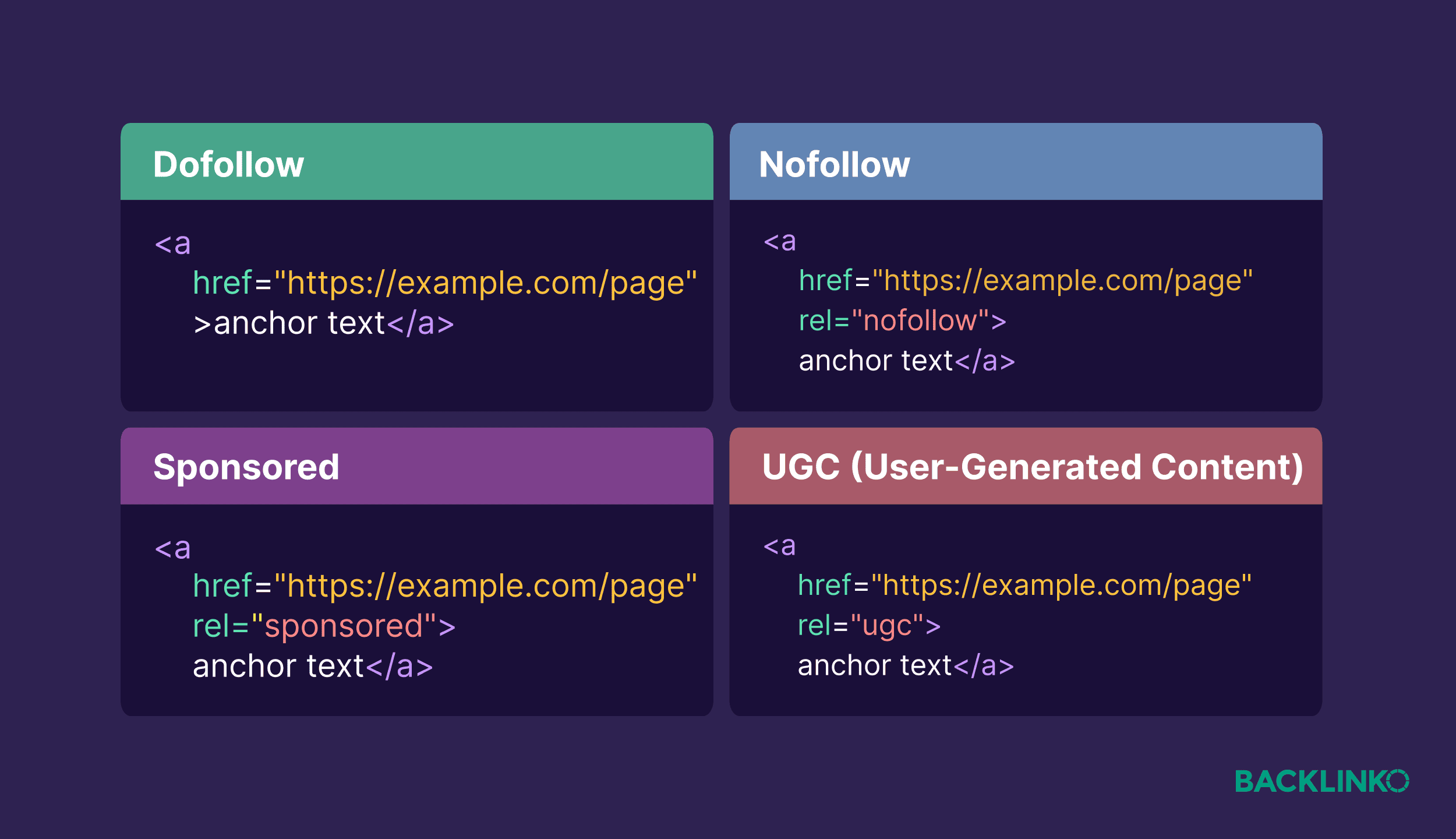
There are a few types, but the two most common are standard (dofollow) links and nofollow links.
A standard link doesn’t need a special attribute. SEOs often call these dofollow links because they pass link equity (or authority) from one site to another.
They’ve been the primary target for backlink campaigns for years.
Nofollow links carry a rel=”nofollow” attribute that signals to Google not to pass link equity. But Google treats this as guidance, not an absolute stop.
Nofollow links can still have value for referral traffic, brand visibility, and broader authority signals.
YETI, for example, has 50 backlinks from Wikipedia, all nofollow.
All of these still matter to search engines and increasingly to AI tools as well.
Are Backlinks Still Important?
Simple answer: Yes. Backlinks still matter because they tell Google your content is credible while teaching AI systems which conversations your brand belongs in.
And the data is pretty clear on this.
For example, our analysis of 11.8 million search results found that the #1 result has 3.8x more backlinks than the pages ranked #2 through #10.
Still, you’ve probably heard that backlinks are dying (along with SEO, good music, and pretty much anything you ever loved).
In 2024, even Google’s Gary Illyes briefly suggested at SERPCon that links were becoming less important as a ranking signal — before correcting himself almost immediately.
That moment captures the current state of the conversation. The underlying reality, though, hasn’t changed.
High-quality, relevant backlinks still matter. And they matter in more than one way.
First, backlinks are important because they’re still a core Google ranking signal.
Google’s original search algorithm was built on backlinks.
In 1998, Larry Page and Sergey Brin created PageRank — an algorithm that treated links between websites like votes of confidence. Pages that earned more links from credible sources (more votes) ranked higher.
Nearly 30 years later, after thousands of changes to their ranking algorithm, backlinks are still a key signal.
They also help Google discover new content. When Googlebot follows a link to a page it hasn’t seen before, that’s often how that page gets indexed for the first time.
Next, backlinks are important because they can drive real referral traffic.
A backlink can act as a door from one trusted website to yours.
Every time someone clicks on a link and lands on your site, that’s a real visitor — no algorithm required.
A single backlink from a high-traffic, relevant publication can send more targeted readers to your site than months of keyword optimization alone.
Lastly, backlinks are still important because they signal authority and trust.
When a reputable site links to your content, it tells search engines, readers, and AI systems that you’re a credible brand with high-quality content.
High-quality backlinks are the foundation of online authority. But the authority they create extends beyond the link itself.
What matters most is that your brand appears in trusted editorial content — linked or not. A backlink is a form of that, but it’s not the only one.
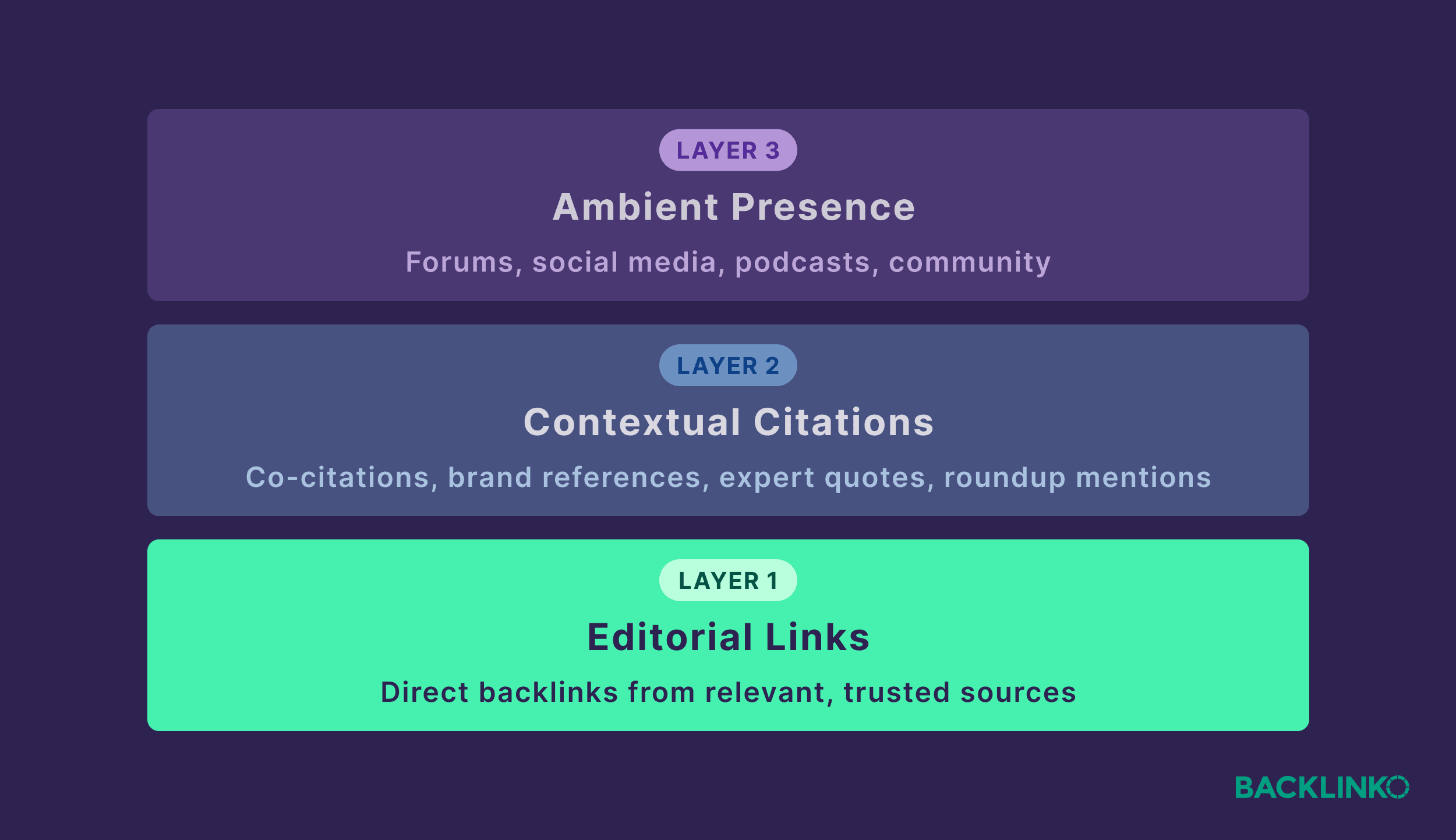
We call this concept the Authority Signal Stack:
Layer 1: A dofollow editorial link that passes link equity to your page and drives referral traffic
Layer 2: Contextual citations and brand mentions in editorial content that AI systems read and learn from (whether linked or unlinked)
Layer 3: The ambient presence that follows naturally, including organic mentions across social, forums, and online communities
Layer 1 is what most SEOs have always focused on.
Layers 2 and 3 are where backlinks and brand mentions start to move into AI visibility.
How Backlinks Work in AI Search Visibility
Backlinks from trusted sources can strengthen your brand’s online authority. At the same time, they help AI systems connect your brand with a specific topic.
This makes it more likely that AI systems will cite your content and recommend your brand or product in the right conversations.
That’s Layer 2 of the Authority Signal Stack. And it’s fundamentally different from a traditional ranking signal.
A Semrush study of 1,000 domains, conducted with researcher Kevin Indig, found that authority matters far more than volume or link attributes for AI visibility.
They also found something that most SEOs didn’t expect: nofollow links performed almost identically to dofollow links.
For AI search, the link attribute appears to be nearly irrelevant.
What matters most is authority.
Let’s take that one step further. If authority is what matters — not the link itself — then appearing in trusted editorial content has value even without a direct link.
AI systems learn from the full context of what they read. So when your brand appears consistently in the same articles as recognized names in your niche, those systems start to associate you with that topic.
SEOs call this co-citation.
For example, the budgeting app YNAB is consistently recommended in roundup lists alongside apps like Copilot, Quicken, PocketGuard, and other bigger competitors.
These co-citations (and other signals) help it appear in AI answers when someone searches for budgeting apps.
(From the citations in this AI response, you can see the Authority Signal Stack’s Layer 3 mentions on forums like Reddit are also doing some heavy lifting.)
Knowing all of this, which backlinks should you prioritize?
What Makes a Backlink High-Quality?
Not all backlinks carry the same weight.
Here are four aspects that separate the ones that are worth pursuing from the ones that aren’t.
Signal 1: Topical Relevance
Today, a link’s value depends on the full editorial context around it, not just the site it’s coming from.
This has been the most important shift in how Google evaluates links in the last few years, and it’s only getting more important.
At a basic level, topical relevance means the linking site covers the same industry or audience as yours.
For example, energy gel brand Skratch Labs sponsors different races, and they get backlinks from those relevant industry websites:
But today, this goes even further.
Every backlink should have clear topical relevance across three areas:
The specific page the link appears on
The content surrounding it
The anchor text
For example, Skratch Labs also has a backlink from a Runner’s World article specifically about how to fuel long runs. The anchor text includes their brand and product names.
This is worth far more than a backlink from a high-authority but low-relevance site.
LLMs learn from the full editorial context of what they read. A link in an article about running and energy gels teaches AI systems that Skratch Labs’ brand belongs in that conversation.
Signal 2: Source Credibility
Google’s systems are built to reward sites that exist to serve their audience. That’s why helpful, reliable content gets more visibility, while spammy or manipulative sites are nearly invisible.
Because of this, when a site shows clear signs of credibility, Google (and AI systems) pay attention to who that site chooses to bless with a backlink or brand mention.
Ask yourself these questions:
First, does it have real organic traffic? A site with no traffic may have been penalized. Or, it may not be established yet. Links from zero-traffic sites add no referral value, and Google is unlikely to weigh them.
Use a tool like Semrush’s Organic Rankings to check the estimated organic traffic before pursuing a link.
Second, does the site have genuine editorial standards? This would include things like real, named authors, bylines, and signs of editorial oversight.
A credible publication behaves like one. The easiest way to see this is to check the website’s About page.
For example, The Spruce’s About page includes full writer profiles, fact-checking processes, and editorial guidelines.
Next, does the site have a healthy link profile? A credible site is cited by other credible sites.
If a potential linking site’s own backlink profile is thin or low-quality, its endorsements won’t compound in the way a genuinely trusted source would.
Use your preferred backlink tool to get a quick read on whether a source has a healthy website authority score.
For a relevant home and garden brand, a backlink from The Spruce would carry real editorial weight. Their traffic is real, their authors are named, and credible sources cite them regularly.
Compare that with a site that has a generic “About Us” page with no real team and a “Write for Us” page accepting paid placements from anyone willing to submit.
It might look credible at first glance. But links from these sites are just transactions. They don’t have the full weight of a high-quality backlink.
Pro tip: Finding a credible, topically relevant site is only the first step. In general, it’s better to earn links from 100 different sites than 1,000 from the same site.
In fact, our search engine ranking correlation study found that the number of sites linking to you (not the total number of backlinks) correlated with Google rankings more than any other factor.
Signal 3: Editorial Placement
The core question here is simple: Did a site link to you because it adds value to their readers?
For example, a journalist cites your research because it’s useful. A pitch is accepted on its own merits — no transaction, just a link that’s there because someone decided it belonged.
Like this link to HubSpot’s State of Marketing report inside an Adobe article about lead nurturing. It’s there because it made sense.
This is what Google’s original PageRank algorithm was designed to reward.
Of course, some editorial placements are paid. A properly disclosed paid link — marked with rel=”sponsored” — tells Google not to pass link equity through it.
Like this sponsored link to Apple inside a Travel & Leisure article about headphones.
The rel=”sponsored” attribute is visible in the code. It won’t pass link equity, but it still drives referral traffic and brand visibility.
On the other hand, an undisclosed paid link, left as a standard dofollow link, violates Google’s link spam policies and risks a manual penalty.
Another practice that could risk a penalty is a link exchange: the classic “I’ll link to you if you link to me.”
An excessive use of this tactic is explicitly named in Google’s spam policies as a link scheme, so it’s best to avoid it.
Then there’s the gray area: guest posts.
In many cases, a well-written piece on a relevant, high-quality site is a legitimate way to earn a link.
Like this Smashing Magazine article by Kate Kalcevich, VP of Innovation at Fable. The guest post covers her team’s research and links back to Fable’s full write-up.
But the same tactic applied at scale across irrelevant sites, purely for the link, is what Google classifies as a scheme.
Editorial placement matters because a dofollow link and an undisclosed paid link look identical at the attribute level.
Google built its spam policies specifically because of that gap — because the attribute alone tells you nothing about whether a link was earned.
Signal 4: Link Status
By now, you know that link attribute alone is no longer a reliable shortcut to quality. The signals we’ve covered — topical relevance, source credibility, and editorial placement — all come before this.
A dofollow link from an irrelevant, low-traffic site isn’t high quality just because it’s a dofollow. And a nofollow link from a credible, relevant source in the right editorial context can be worth considerably more.
Each attribute type serves a distinct purpose. The right one depends on what you’re trying to achieve.
Here’s a full picture of what each attribute actually does and how they affect the quality of backlinks depending on your goals.
Dofollow: Best for passing link equity directly to your site and improving Google rankings
Nofollow (rel=“nofollow”): Best when the editorial context is closely matched
Sponsored (rel=“sponsored”): Best for brand visibility in paid placements and affiliate programs
UGC links (rel=”ugc”): Best for flagging user-generated content like forum posts, comments, and community threads (these fall into Layer 3 of our Authority Signal Stack)
So, which one of these is best?
Actually, all of them. A healthy backlink profile should include a mix of all four of these link attributes.
How to Start Building Backlinks
The best link-building methods share a common thread: They all get trusted sources to mention your brand in their content — linked or unlinked.
That’s what builds ranking authority for Google and editorial presence for AI.
Here are three simple ways to get started with link building.
Strategy 1: Become a Helpful Source
Reporters and content creators are constantly looking for expert input.
Platforms like Connectively, Qwoted, or MentionMatch connect you directly to relevant requests. Answer as an expert source, and if your response gets used, you may earn a backlink or a relevant mention.
This is the easiest way to get started because you don’t need to build an existing audience or a cold outreach list.
And it really works: Greg Heilers of Jolly SEO has sent over 200,000 pitches like these across his projects. Of his last 1,000 backlinks earned with this method, more than 600 came from Connectively (formerly Featured) alone.
Original data, free tools, and calculators earn backlinks organically — writers and journalists need primary sources to cite.
The asset has to be specific enough to be genuinely useful, and published on its own page so it can be linked to directly.
For example, just look at Wistia’s State of Video Report.
Built from a survey of 900+ professionals and data from 13 million videos, the report has earned over 4,000 backlinks from more than 1,000 referring domains.
Why? Because it’s the kind of data writers covering this topic can’t get anywhere else.
A well-made asset doesn’t just earn backlinks.
It also earns the kind of editorial citations that AI tools draw on when answering questions.
Strategy 3: Create an Outdated or Broken Link Campaign
When a resource on the web goes dark — a brand closes, a page gets deleted, a study gets pulled — every link still pointing to it is now broken.
Find those broken links, let the site owner know, and offer your content as a replacement.
When you find topically relevant, credible sites to do this, you’ll get the kind of strong backlinks that make up the foundation of the Authority Signal Stack.
Plus, you help them solve a problem they didn’t even know they had.
Here are a couple of ways to discover these opportunities.
Some websites include resource pages that contain useful links to external websites. If these pages contain dead links, you might be able to inherit them.
To find these pages, do a manual search with Google search operators like:
“Useful links” AND [topic]
[topic] intitle: “useful resources”
[topic] inurl:resources
Then, check if any of the links on that page are broken.
You can also use a tool like Semrush’s Backlinks tool to analyze your competitor’s site and find broken backlinks.
In the Backlinks tool, type in your competitor’s website.
Then head to “Indexed Pages” and select “Broken Pages” to see broken pages on your competitor’s site that still have backlinks pointing to them.
When you find a source that’s relevant to your brand, you can send a message to see if they’ll replace the broken link with your link.
The agency Nico Digital did this. They found a competitor’s deleted pricing page that still had over 3,000 referring domains pointing to it.
What’s the Difference Between a Backlink and an Internal Link?
A backlink is a link from an external site to yours. An internal link connects two pages on the same website.
Both matter for SEO, but do different jobs. Backlinks build authority from the outside. Internal links help Google understand your site’s structure and pass authority between your own pages.
What’s a Referring Domain?
A referring domain is a website that links to yours. It’s distinct from total backlink count — a single domain can link to you multiple times, but it still counts as one referring domain.
Getting links from many different referring domains is generally more valuable than getting multiple links from the same site.
What’s a Backlink Profile?
Your backlink profile is the full collection of backlinks pointing to your website — every site linking to you, the pages they link to, the anchor text they use, and the mix of dofollow and nofollow attributes across all of them.
It’s what backlink checker tools show you when you audit your site.
A healthy backlink profile has variety: links from different referring domains, topically relevant sources, and a natural mix of anchor text rather than the same keyword phrase repeated across every link.
Paid tools like Semrush go deeper, with historical data and competitor comparisons.
Look at three things: which sites are linking to you, how credible each one is, and whether any look spammy or low-quality. That’s the foundation of a healthy backlink profile.
Now You Know What Backlinks Are — Time to Build Them
Every backlink you evaluate from here on should be judged by more than its attribute. Ask whether it’s relevant, whether it comes from a credible source, and whether it was earned.
Those are the things that determine whether it functions as a real citation, not just a vote.
It scores each signal automatically and gives you an overall rating, so you can see exactly where a link is strong and where it’s not.
From there, the bigger opportunity is visibility beyond traditional rankings. Our guide to AI search strategy walks through how to build on everything you’ve learned here.